

Wednesday, March 4, 2026
Home Blog Page 5

The Remarkable Journey of Shubhanshu Shukla

0
Shubhanshu Shukla
Shubhanshu Shukla | First Indian on ISS | Astronaut Profile

I remember the first time I heard about Shubhanshu Shukla. It was during a random conversation with a colleague who mentioned this “brilliant mind from Lucknow” who was “quietly revolutionizing” his field. I nodded politely but made a mental note to look him up later. Little did I know that this casual reference would send me down a fascinating rabbit hole, exploring the journey of one of India’s most intriguing yet understated talents.

There’s something uniquely captivating about people who achieve remarkable things without chasing the spotlight. In a world obsessed with Instagram followers and viral moments, Shubhanshu Shukla represents something increasingly rare: substance over spectacle, depth over display.

But wait, I’m getting ahead of myself. Let me back up a bit.

The Early Chapters | How Shubhanshu Shukla’s Roots Shaped His Vision

How Shubhanshu Shukla's Roots Shaped His Vision

Childhood often holds the keys to understanding exceptional individuals. For Shubhanshu Shukla, growing up in Uttar Pradesh wasn’t just about geography. It was about absorbing a particular worldview, a specific cultural ethos that would later inform his approach to life and work.

Born into a middle-class family where education was revered above all else, young Shubhanshu developed an insatiable curiosity early on. His father, a dedicated civil servant, and his mother, a literature enthusiast, created an environment where questions were encouraged and books were treasured. This wasn’t the stereotypical “doctor or engineer” household that dominated much of India’s middle-class landscape in the 1990s. Instead, it was a home where ideas flourished and conventional paths were questioned.

“I was that annoying kid who kept asking ‘why’ until adults ran out of answers,” Shubhanshu once mentioned in an interview with The Hindu. “Fortunately, my parents didn’t see this as defiance they saw it as healthy intellectual curiosity.”

The School Years | Beyond Textbooks

At DAV Public School, where Shubhanshu spent his formative academic years, teachers quickly noticed his unusual approach to learning. He wasn’t just memorizing facts he was connecting dots across subjects, finding patterns where others saw only isolated information.

One particular incident stands out. During a standard science fair project in Class 9, while other students created predictable volcano models or simple electric circuits, Shubhanshu designed an elaborate system to demonstrate how traditional Indian water conservation methods could be modernized for contemporary urban settings. It won first prize not just for execution but for bridging ancient wisdom with modern problems. A theme that would later become central to his professional identity.

But school wasn’t all academic glory. Like many thoughtful, introspective children, Shubhanshu struggled with the social dynamics of adolescence. “I was terrible at cricket, absolutely hopeless,” he laughed during a podcast appearance last year. “In India, being bad at cricket is practically a social handicap for a teenage boy. But it forced me to find my own path rather than following the crowd.”

The Turning Point | When Shubhanshu Shukla Found His True Calling

Everyone has pivotal moments that redirect their life’s trajectory. For Shubhanshu Shukla, that moment came during his undergraduate years at a time when most of his peers were robotically preparing for entrance exams to secure the “right” post-graduate qualifications.

I’ve always found it fascinating how sometimes the most significant decisions in our lives happen almost accidentally. In Shubhanshu’s case, it was an impromptu visit to a lecture that wasn’t even part of his curriculum. The topic was the intersection of technology and traditional knowledge systems. How India’s ancient wisdom could inform modern solutions to contemporary problems.

“I walked into that hall as one person and walked out as someone else entirely,” he later wrote in his blog. “It was like someone had suddenly turned on all the lights in a room I’d been fumbling around in.”

This wasn’t just about finding an interesting topic, It was about discovering a purpose. In a country racing toward westernization and modernity, Shubhanshu recognized the value of India’s indigenous knowledge systems. But unlike the purists who rejected progress in favor of tradition, he saw potential for synthesis, A bridge between worlds that could honor heritage while embracing innovation.

And frankly, this is where things get really interesting.

The Academic Foundation

Following this epiphany, Shubhanshu Shukla pursued higher education with renewed focus. His academic journey wasn’t linear—it zigzagged through multiple disciplines, drawing from various wells of knowledge.

After completing his undergraduate studies in Computer Science from IIT Kanpur, he made what many considered a strange detour: a Master’s in Sanskrit and Indian Knowledge Systems from Banaras Hindu University. To his friends and family, this seemed like career suicide. Why would someone with an IIT degree venture into humanities?

“People thought I’d lost my mind,” Shubhanshu recalled during his TEDx talk in Bangalore. “The standard response was ‘Sanskrit? What will you do with that?’ As if education is only valuable if it directly translates to a salary bracket.”

But Shubhanshu had a vision few others could see: the possibility of creating technological solutions deeply rooted in Indian philosophical frameworks. Not as a gimmick or marketing angle, but as a fundamentally different approach to innovation.

Professional Milestones | Tracking Shubhanshu Shukla’s Remarkable Career Trajectory
Tracking Shubhanshu Shukla's Remarkable Career Trajectory

Like many truly original thinkers, Shubhanshu Shukla’s career defies easy categorization. Is he an entrepreneur? A researcher? A thought leader? A social innovator? He’s all of these things and somehow also none of them, at least not in the conventional sense.

His professional journey began conventionally enough with a stint at a major tech corporation in Bangalore. But after just eighteen months during which he performed exceptionally well according to all metrics he resigned. His colleagues were baffled. His parents were concerned. His former professors wondered if they’d misjudged his potential.

“It was a comfortable cage,” he explained in a rare personal blog post. “Great salary, prestigious company, impressive business card and absolutely zero connection to the work that actually moved my soul.”

What followed was a two-year period that Shubhanshu himself describes as his “wilderness years.” He traveled extensively throughout rural India, documenting traditional practices in water management, sustainable architecture, and indigenous healthcare. Not as a tourist or even as an academic researcher, but as a student sitting humbly at the feet of village elders and tribal knowledge-keepers.

These weren’t easy years financially or socially. In a culture that values stability and clear career progression, Shubhanshu’s choices raised eyebrows. “My relatives stopped asking what I was doing,” he once joked. “They assumed I’d either gone completely mad or joined some cult.”

The Breakthrough Moment

The turning point came in 2016 when Shubhanshu Shukla founded Paramparik Innovations. The venture began with a simple premise: what if India’s ancient knowledge systems could be applied to solve modern urban challenges?

Their first project tackled Bangalore’s water crisis by redesigning apartment complexes using principles derived from step-well architecture. The results were remarkable—buildings that reduced water consumption by 60% while creating aesthetically stunning community spaces.

What made this work especially significant wasn’t just its practical success but its philosophical foundation. Shubhanshu wasn’t simply applying technological fixes to environmental problems; he was challenging the very framework through which we understand the relationship between humans, resources, and built environments.

“Western sustainability often positions humans as problems to be solved—consumers whose impact must be minimized,” he explained during a panel at the India Economic Summit. “Our traditional knowledge systems see humans as potential solutions—stewards whose thoughtful interactions can actually enhance natural systems.”

This perspective earned Paramparik Innovations recognition far beyond India’s borders. By 2018, they were collaborating with urban planners in Singapore, environmental engineers in Germany, and sustainability experts in Scandinavia.

The Philosophy Behind the Work | Understanding Shubhanshu Shukla’s Unique Approach

Understanding Shubhanshu Shukla's Unique Approach

If I had to distill Shubhanshu Shukla’s philosophy into a single idea, it might be this: true innovation doesn’t require abandoning tradition; rather, the most sustainable path forward often involves rediscovering wisdom we’ve forgotten.

This isn’t about blind reverence for the past. Shubhanshu is far too pragmatic for that. Instead, his approach involves a critical examination of traditional knowledge systems, identifying principles that remain relevant, and applying them using contemporary methods and technologies.

“Ancient doesn’t automatically mean superior,” he cautioned during a workshop in Chennai last year. “Not everything our ancestors did was brilliant. But dismissing millennia of contextual knowledge and lived experience without examination is equally foolish.”

Take, for instance, his work on urban farming initiatives in Pune. Rather than simply importing vertical farming technologies from Singapore or the Netherlands, his team studied traditional Indian companion planting techniques used for centuries by farmers in diverse climatic regions. They then developed a hybrid system that consumed 40% less water and reduced pest problems without chemical interventions.

Beyond Technology | The Social Dimension

What truly sets Shubhanshu Shukla apart, I think, is his understanding that technical solutions alone cannot address our most pressing challenges. The social dimension of how innovations are integrated into communities and cultures matters just as much as the innovations themselves.

“Technology without cultural context is like a heart transplant without blood type matching,” he once remarked at a conference in Mumbai. “No matter how advanced the solution, if it doesn’t honor the cultural reality of the people using it, rejection is inevitable.”

This insight led to one of his most successful initiatives: the Gram Vidya program, which partners engineering students from elite institutions with rural artisans and farmers. The students learn traditional knowledge systems while offering their technical skills to help scale indigenous innovations. The result? A remarkable exchange that benefits both groups while producing solutions that are both technically sound and culturally appropriate.

Looking Forward | Where Will Shubhanshu Shukla’s Journey Lead Next?

If Shubhanshu Shukla’s past is any indication of his future, we can expect continued evolution rather than simple expansion. He’s not the type to grow his existing ventures larger just for growth’s sake. Instead, he seems drawn to new challenges that allow him to apply his unique perspective in different contexts.

Recent rumors suggest he’s been spending significant time in the healthcare sector, exploring how India’s traditional medical systems might inform more holistic approaches to public health challenges. Given India’s strained healthcare infrastructure and the growing global interest in integrative medicine, this could represent his most impactful work yet.

“Our healthcare systems are excellent at acute intervention but struggle with prevention and chronic care,” he noted during a recent panel discussion. “Traditional systems offer sophisticated frameworks for understanding health as a dynamic balance rather than merely the absence of disease.”

But I suspect Shubhanshu’s influence will ultimately extend far beyond any single sector or innovation. His most enduring contribution may be methodological teaching others how to build these bridges between traditional wisdom and contemporary challenges.

The Educational Initiative

This might explain his recent focus on education. The Vidyashala Fellowship, launched last year, brings together promising young innovators from across India for an intensive two-year program. Fellows spend time learning both from academic experts and traditional knowledge-holders, developing projects that address community needs while drawing on indigenous wisdom.

“We’re not just training individuals; we’re cultivating a new approach to innovation itself,” Shubhanshu explained at the fellowship’s inauguration. “India doesn’t need to choose between ancient wisdom and cutting-edge science; our unique contribution to global progress might lie precisely in the synthesis of these seemingly opposing forces.”

The Personal Side | Who is Shubhanshu Shukla Beyond the Professional Achievements?

Despite his growing public profile, Shubhanshu Shukla maintains a relatively private personal life. Those who know him well describe someone whose public and private personas align closely thoughtful, curious, occasionally absent-minded when deeply engaged with ideas, and possessing an unexpected sense of humor that emerges in casual conversation.

He starts each day with yoga and meditation not as trendy wellness practices but as disciplines he’s maintained since childhood. He reads voraciously across disciplines, with a particular fondness for poetry. And despite his busy schedule, he makes time to teach a weekly class on systems thinking at a government school in Bangalore.

“Success means nothing if it disconnects you from everyday people and everyday experiences,” he mentioned during a convocation address last year. “The moment you start seeing yourself as exceptional rather than fortunate, you lose the very perspective that makes your work valuable.”

Family and Home

Shubhanshu’s connection to his roots remains strong. Despite his international recognition, he returns to his hometown in Uttar Pradesh several times a year, especially during important festivals. His parents, now retired, take enormous pride in his accomplishments but seem equally pleased that he still enjoys his mother’s home-cooked meals and engages in lengthy philosophical debates with his father.

In Bangalore, where he now lives, his apartment reflects his philosophical approach—minimalist yet warm, featuring crafts from artisan communities he’s worked with, and dominated by an impressive library organized not by subject but by “conversations between authors across time and space”. One shelf might contain ancient Vedic texts alongside contemporary physics papers and environmental case studies connections obvious to him if bewildering to visitors.

The Legacy of Shubhanshu Shukla | Building Bridges Between Worlds

As I wrap up this exploration of Shubhanshu Shukla’s journey, I find myself reflecting on what makes his contribution truly significant. In a world increasingly divided between those who worship at the altar of technological progress and those who idealize a return to simpler times, Shubhanshu offers a third path, one that honors the wisdom of tradition while embracing the possibilities of innovation.

His work reminds us that India’s contribution to global challenges need not involve simply adopting Western models or retreating into cultural exceptionalism. Instead, there’s profound potential in synthesis in creating approaches that draw from multiple knowledge systems to address our most pressing problems.

What makes Shubhanshu Shukla’s story particularly relevant for today’s India is that it offers a vision of modernization that doesn’t require cultural amnesia. At a time when many young Indians feel forced to choose between tradition and progress, his path demonstrates how these apparent opposites might instead become complementary forces.

I began this article by mentioning how a casual reference sent me down a rabbit hole exploring Shubhanshu’s work. I’ll end by suggesting that his greatest impact may lie not in any single innovation or project, but in inspiring others to explore similar rabbit holes—to question false dichotomies, to see value in knowledge systems beyond their own, and to build bridges between worlds too often kept apart.

And in a world desperately in need of bridge-builders, that might be the most valuable contribution of all.

FAQs

What educational background does Shubhanshu Shukla have?

Shubhanshu Shukla holds a Bachelor’s degree in Computer Science from IIT Kanpur and a Master’s in Sanskrit and Indian Knowledge Systems from Banaras Hindu University. This unusual combination reflects his core philosophy of bridging traditional wisdom with contemporary technology. He’s also completed specialized programs in sustainable development and systems thinking from institutions both in India and abroad.

How did Shubhanshu Shukla start his career?

After graduating from IIT, Shubhanshu Shukla initially followed a conventional path by joining a major tech corporation in Bangalore. However, after eighteen months, he resigned to pursue a deeper understanding of traditional knowledge systems by traveling throughout rural India for two years. This period of immersion led to the founding of Paramparik Innovations in 2016, which marked the true beginning of his distinctive career path.

What are Shubhanshu Shukla’s most significant achievements?

Among Shubhanshu Shukla’s most notable achievements is developing urban water management systems based on traditional step-well principles, which reduced consumption by 60% in pilot projects. He also created the Gram Vidya program connecting engineering students with rural knowledge-holders and founded the Vidyashala Fellowship. In 2021, he was recognized by the World Economic Forum as one of their “Young Global Leaders” for his innovative approach to sustainable development.

Is Shubhanshu Shukla active on social media platforms?

Yes, Shubhanshu Shukla maintains a thoughtful presence on select social media platforms, particularly Twitter and LinkedIn, where he shares insights about his work and philosophy. However, unlike many public figures, his social media usage is purposeful rather than promotional. He typically posts in-depth analyses of complex issues rather than personal updates. His quarterly newsletter, “Bridges,” has gained a dedicated following for its exploration of connections between traditional wisdom and contemporary challenges.

How can someone collaborate with Shubhanshu Shukla on projects?

Shubhanshu Shukla selects projects based on alignment with his core values rather than commercial potential alone. His organization, Paramparik Innovations, has an open submission process for collaboration proposals on their website. He’s particularly interested in initiatives that address community needs through participatory approaches. Additionally, the Vidyashala Fellowship accepts applications from young innovators interested in his methodology of bridging traditional and modern knowledge systems.

What books or resources has Shubhanshu Shukla recommended for understanding his approach?

While Shubhanshu Shukla hasn’t yet published a book of his own (though rumors suggest one may be forthcoming), he often recommends works that have influenced his thinking. These include “Traditional Knowledge Systems of India” by Kapil Kapoor, “Cradle to Cradle” by William McDonough, “Gandhi’s Hind Swaraj” with its emphasis on appropriate technology, and “Thinking in Systems” by Donella Meadows. His own writing can be found in various academic journals and through his quarterly newsletter.

Do I Have Misophonia? Understanding and Taking a Misophonia Test in India

0
Misophonia test
Misophonia Test Online | Self‑Assess Sound Sensitivity

Have you ever felt your blood pressure skyrocket when someone nearby starts chewing loudly? Or maybe the sound of a coworker repeatedly clicking their pen makes you want to scream? If certain everyday sounds trigger an intense emotional response in you, one that seems completely disproportionate you might be experiencing misophonia.

I remember sitting in a crowded Delhi restaurant, trying to enjoy dinner with friends, when the man at the next table began slurping his soup. What followed was a surge of anxiety, anger, and an overwhelming urge to flee that I couldn’t explain to my confused companions. That was my first conscious recognition that something unusual was happening with how my brain processed certain sounds.

But is this actually misophonia? And how common is it here in India? These are questions that led me down the rabbit hole of misophonia testing and diagnosis.

My Journey to Understanding Misophonia Test Results

My Journey to Understanding Misophonia Test Results

The word “misophonia” literally means “hatred of sound,” but that’s an oversimplification that doesn’t capture the complexity of this condition. After years of being told I was “too sensitive” or “overreacting” to normal sounds, finding out there was an actual name for my experiences was both validating and terrifying.

When I first researched misophonia in the Indian context, I found surprisingly little country-specific information. Most resources were from Western countries, leaving me wondering if misophonia was even recognized by healthcare providers here. Turns out, it is though awareness remains limited compared to more common conditions.

The journey to getting properly assessed wasn’t straightforward. Unlike testing for hearing loss, which is standardized and widely available across India, misophonia assessment requires a more specialized approach. And honestly? I almost gave up several times along the way.

My first attempt at self-diagnosis involved random online quizzes that felt about as scientifically valid as determining my Hogwarts house. But desperate for answers, I completed them anyway, screenshot-ing results to show my increasingly skeptical family members.

Why Taking a Misophonia Test Changed My Perspective on Sound Sensitivity

Before actually taking a proper misophonia test, I’d convinced myself I was simply intolerant and short-tempered. This self-blame only added another layer of suffering to an already challenging condition.

The most eye-opening aspect of eventually taking a structured misophonia assessment was realizing I wasn’t alone. The questionnaires asked about specific triggers and reactions that matched my experiences, exactly things I’d never shared with anyone for fear of judgment.

The Revelation of Validation

There’s something profoundly healing about having your experiences validated. When the audiologist in Mumbai reviewed my responses and nodded in recognition, saying “This is textbook misophonia,” I nearly cried with relief. It wasn’t “all in my head” after all or rather, it was, but in a neurological sense that wasn’t my fault.

The testing process helped me understand that misophonia exists on a spectrum. Some people experience mild irritation at certain sounds, while others have severe reactions that significantly impact daily functioning. Learning where I fell on this spectrum gave me a framework for understanding my triggers and responses.

But wait—I’m getting ahead of myself. You’re probably wondering what a misophonia test actually involves and whether you should consider taking one yourself.

Finding the Right Misophonia Test in India | Options and Accessibility

Finding the Right Misophonia Test in India | Options and Accessibility

Let’s be honest—misophonia testing in India isn’t as straightforward as getting your eyes or blood pressure checked. The condition still flies under the radar in many medical circles, but things are improving.

Professional Assessment Options

If you’re looking for a professional misophonia test in India, your best bet is to start with one of these specialists:

  • Audiologists – Many audiologists, particularly in metropolitan areas like Delhi, Mumbai, Bangalore, and Chennai, now offer misophonia assessments. The All India Institute of Medical Sciences (AIIMS) in Delhi has specialists familiar with the condition.
  • ENT Specialists – Some otolaryngologists (ear, nose, and throat doctors) have experience with misophonia, though you might need to call ahead and specifically ask.
  • Psychiatrists and Neurologists – Since misophonia has both neurological and psychological components, these specialists may offer testing, particularly at institutions like NIMHANS in Bangalore.

When I finally decided to seek professional help, I called six different clinics before finding one that even recognized the term “misophonia.” That was in 2018. Today, awareness has improved, but it still requires some persistence.

The actual misophonia test I underwent involved a combination of:

  • A detailed interview about my trigger sounds and reactions
  • Standardized questionnaires measuring sensitivity and response intensity
  • Hearing tests to rule out other auditory conditions
  • In some cases, exposure to potential trigger sounds to observe reactions

Price-wise, expect to pay between ₹1,500-4,000 for a comprehensive assessment, depending on the facility and city. Some insurance plans may cover this under psychological or audiological testing, but many still don’t—something that hopefully changes as awareness grows.

Self-Assessment Options

Can’t access professional testing right now? I get it. Healthcare access in India varies dramatically depending on location and resources. While self-assessment isn’t a substitute for professional diagnosis, it can help you understand if pursuing formal testing makes sense.

Some relatively reliable self-assessment options include:

  • The Misophonia Assessment Questionnaire (MAQ)
  • The Amsterdam Misophonia Scale (A-MISO-S)
  • The Duke Misophonia Questionnaire

You can find adaptations of these online, though I’d recommend discussing your results with a healthcare provider when possible.

How to Prepare for Your Misophonia Test | What I Wish I’d Known

If you’re considering getting tested for misophonia, there are things I wish someone had told me before my appointment. Would have saved me some anxiety and confusion!

Tracking Your Triggers

Before my misophonia test, I spent two weeks keeping a “trigger journal” documenting:

  • Specific sounds that bothered me
  • My emotional and physical reactions
  • The intensity of my response (on a 1-10 scale)
  • Circumstances (Was I stressed? Tired? Hungry?)

This preparation proved invaluable during my assessment. My doctor was impressed with the detailed data, which helped pinpoint patterns I hadn’t even noticed myself. For instance, my reactions were significantly worse when I was sleep-deprived—something that helped inform my management strategy later.

The journal revealed that my triggers weren’t just random. They clustered around specific categories: mouth sounds, repetitive sounds, and certain speech patterns.

Emotional Preparation

Here’s something they don’t tell you: misophonia testing can be emotionally draining. During my assessment, I had to listen to recordings of trigger sounds, which left me feeling agitated and exhausted afterward.

I’d recommend:

  • Scheduling your test when you don’t have other commitments afterward
  • Bringing someone supportive with you if possible
  • Planning a calming activity for after the appointment

And perhaps most importantly—prepare for a range of potential outcomes. Misophonia exists on a spectrum, and its classification is still evolving in the medical community.

How to Interpret Your Misophonia Test Scores | Beyond the Numbers

After completing a misophonia test, you’ll typically receive some form of numerical score or classification. But what do these numbers actually mean?

When I received my results, I was classified as having “moderate to severe” misophonia. But that clinical language didn’t capture what I was experiencing. The audiologist explained that the scoring helped guide treatment approaches but wasn’t a perfect reflection of my lived experience.

Common Misophonia Assessment Scales

Different tests use different scoring systems:

  • The Misophonia Questionnaire (MQ) uses a 0-24 point scale for the Misophonia Symptom Scale and a 0-15 point scale for the Misophonia Emotions and Behaviors Scale
  • The Amsterdam Misophonia Scale rates severity from 0-4 (subclinical) to 24-40 (extreme)

What matters more than the absolute numbers is understanding what your results mean for daily life and management strategies.

Looking Beyond the Score

My audiologist helped me understand that misophonia isn’t just about sound sensitivity—it’s about the brain’s response to certain sounds. My test revealed several interesting patterns:

  • My triggers were primarily human-generated sounds rather than environmental ones
  • Visual triggers (seeing someone chew gum, for example) could produce the same response as auditory ones
  • My emotional reactions followed a specific pattern: irritation → anger → anxiety → need to escape

This detailed breakdown proved far more useful than the overall severity score in developing coping mechanisms.

It’s worth noting that misophonia testing in India often uses assessment tools developed in Western countries. While the condition itself doesn’t appear to vary culturally, some context-specific triggers might be missed. For instance, my assessment didn’t initially capture my severe reaction to the sound of pressure cooker whistles—a common sound in Indian kitchens but less prevalent in Western countries where many assessment tools originated.

What Happens After Your Misophonia Test? Treatment Paths in India

Receiving a misophonia diagnosis—whether mild, moderate, or severe—is just the beginning. The next question is: what now?

I’ll be brutally honest. When I asked my doctor about treatment options, his response was frustratingly vague. “We’re still learning about this condition,” he said, before suggesting a combination of therapy approaches.

The reality is that misophonia treatment in India is still developing. However, several approaches have shown promise:

Therapeutic Approaches Available in India

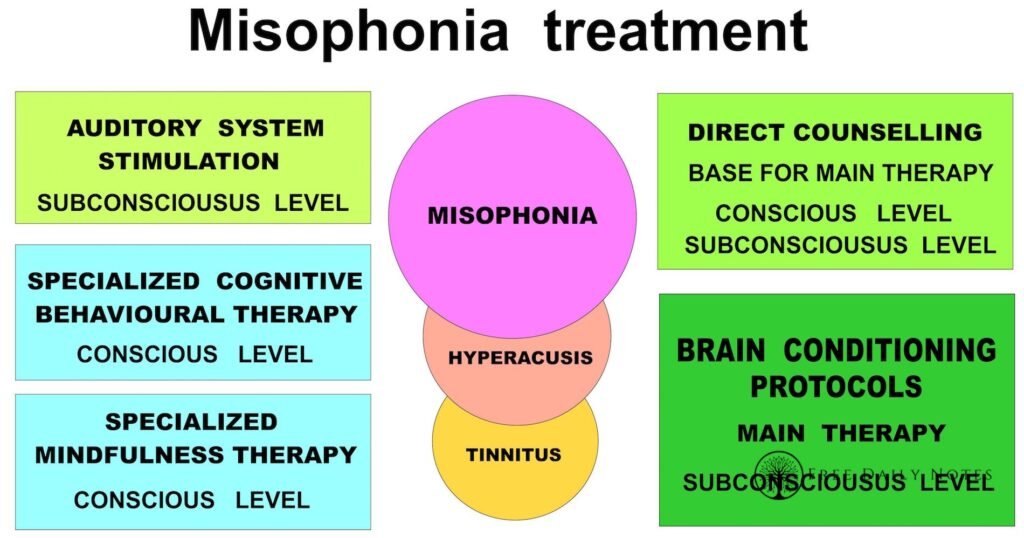
  1. Cognitive Behavioral Therapy (CBT) – Many psychological wellness centers in major Indian cities offer CBT that can be adapted for misophonia. The technique helps develop healthier responses to trigger sounds.
  2. Tinnitus Retraining Therapy (TRT) – Though originally developed for tinnitus, some audiologists in India have modified this approach for misophonia with positive results.
  3. Mindfulness and Meditation – India has a rich tradition of mindfulness practices that can be particularly beneficial for managing the emotional response to triggers. Several centers in Rishikesh and Dharamshala offer programs specifically for sensory sensitivities.
  4. Sound Therapy – Some audiologists provide customized sound therapy that gradually desensitizes the brain to trigger sounds.

When exploring these options, I found that costs varied dramatically—from around ₹1,000 per session for therapy to ₹25,000+ for comprehensive treatment programs. Unfortunately, coverage for these treatments under most Indian health insurance plans remains limited.

Self-Management Strategies

While professional treatment is ideal, many of us with misophonia in India rely heavily on self-management strategies:

  • Environmental modifications – Using noise-cancelling headphones (a lifesaver during my commute on Delhi Metro), white noise machines, or strategic seating arrangements
  • Communication strategies – I’ve found that explaining misophonia to close family and colleagues in a non-accusatory way has led to simple accommodations that make a huge difference
  • Stress reduction – Regular yoga and pranayama have noticeably reduced my reaction intensity during trigger exposures

The journey of managing misophonia isn’t linear. Some days are better than others, and certain environments will always be more challenging. The key insight from my testing process was learning that while I might not be able to eliminate my sound sensitivity, I could develop tools to prevent it from controlling my life.

Misophonia Test for Children and Adolescents | Special Considerations in the Indian Context

While my misophonia symptoms began in childhood, they weren’t recognized until adulthood—a common story for many Indians with this condition. The testing process for children and adolescents requires additional sensitivity and context.

In traditional Indian family structures where multiple generations often live together, children’s complaints about sounds may be dismissed as misbehavior or lack of respect. I’ve spoken with several young adults who were punished for their reactions to family members’ eating sounds or other triggers.

If you’re a parent concerned about your child’s sound sensitivity, it’s worth noting that misophonia assessment for children in India typically involves:

  • More family involvement in the testing process
  • Age-appropriate questionnaires
  • Observation of reactions in controlled environments
  • School feedback where possible

The Child Development Center at several major hospitals, including those in Hyderabad and Chennai, now offer pediatric misophonia assessment, though specialized testing may require travel to metropolitan areas.

One mother I spoke with in Pune described having to travel to Mumbai for her 13-year-old son’s assessment, only to be told initially that he was “just being difficult.” It took three different specialists before finding one who recognized the symptoms of misophonia and provided appropriate testing.

Distinguishing Misophonia from Other Conditions | What Your Misophonia Test Results Really Mean

One critical aspect of misophonia testing is differential diagnosis determining whether your symptoms are indeed misophonia or something else. This distinction matters significantly for treatment approaches.

During my assessment process, we explored several other possibilities:

Hyperacusis vs. Misophonia

Hyperacusis involves pain or discomfort in response to ordinary sound volumes. While I was sensitive to certain sounds, my reaction was emotional rather than painful, pointing to misophonia rather than hyperacusis.

Auditory Processing Disorder

This condition involves difficulty processing what you hear. My hearing and processing were normal—it was specific sounds that triggered me regardless of volume, clarity, or context.

Sensory Processing Sensitivity

This broader sensitivity can include sound but extends to other senses. While I do have some light sensitivity, my sound triggers were specific and consistent with misophonia.

Anxiety Disorders

Sound sensitivity can be a symptom of various anxiety disorders. My testing included psychological assessment to determine whether the sound sensitivity was primary or secondary to anxiety. In my case, anxiety sometimes resulted from misophonia rather than causing it.

Understanding these distinctions helped me focus on misophonia-specific management strategies rather than more general approaches.

The Future of Misophonia Testing and Treatment in India

The landscape for misophonia diagnosis and treatment in India is evolving rapidly. When I first sought help five years ago, I had to explain the condition to healthcare providers. Today, awareness has improved significantly.

Several promising developments suggest better testing and treatment options on the horizon:

  • Telemedicine options – Specialists in major cities are increasingly offering remote consultations, making assessment more accessible for those in smaller towns and rural areas.
  • Research initiatives – Institutions like AIIMS have begun including misophonia in broader research on auditory processing disorders.
  • Support networks – Online and in-person support groups specifically for Indians with misophonia have emerged in cities like Bangalore, Mumbai, and Delhi.
  • Integration with traditional practices – Some practitioners are exploring the integration of traditional Indian practices like specific yoga and pranayama techniques with conventional misophonia management.

While these developments are encouraging, we still have a long way to go before misophonia testing becomes standardized and widely available across India. For now, persistence and self-advocacy remain essential parts of the journey.

Frequently Asked Questions

How do I know if I need a misophonia test rather than just being irritable?

If you’re wondering whether your sound sensitivity warrants a misophonia test, consider the intensity and specificity of your reactions. Occasional irritation at loud chewing is normal; feeling overwhelming rage, anxiety, or a desperate need to escape when hearing these sounds suggests misophonia. The key difference is that misophonia triggers cause an immediate, involuntary emotional response that feels completely out of proportion.

Where can I take a reliable misophonia test in smaller Indian cities?

Finding a misophonia test outside major metropolitan areas in India can be challenging. If you’re in a smaller city, start by consulting audiologists or psychiatrists, specifically asking if they’re familiar with misophonia assessment tools. If local options are limited, consider telehealth consultations with specialists in larger cities; many now offer preliminary misophonia test assessments online, followed by an in-person visit if necessary.

Will my health insurance cover a misophonia test in India?

The coverage for misophonia test procedures under Indian health insurance remains inconsistent. Most government health schemes don’t explicitly cover misophonia assessment, though they might cover it under broader psychiatric or audiological evaluation categories. Private insurers vary widely—some newer comprehensive plans include specialized testing, while others consider it elective.

How is a misophonia test different from a regular hearing test?

A regular hearing test and a misophonia test evaluate completely different aspects of auditory processing. A standard hearing test determines if you can physically detect sounds at various frequencies and volumes, essentially checking if your ears work properly. A misophonia test, however, evaluates your emotional and physiological reactions to specific sound patterns, regardless of volume.

Can children take a misophonia test, and how is it different?

Children absolutely can and sometimes should take a misophonia test when showing signs of sound sensitivity. The assessment process for kids is modified to be age-appropriate and typically involves more parent/caregiver input. Rather than lengthy questionnaires, younger children might participate in play-based assessments where their reactions to various sounds are observed. School-aged children may use simplified rating scales with faces showing different emotions.

What happens if my misophonia test shows severe sensitivity?

If your misophonia test indicates severe sensitivity, don’t panic; this actually opens doors to more targeted help. A severe classification typically leads to a more comprehensive management plan, potentially including specialized therapy, sound desensitization protocols, and more aggressive environmental modifications.

G7 Summit 2025 | What It Means for India and the Changing Global Order

0
G7 Summit 2025
G7 Summit 2025 in Canada | Dates, Leaders & Key Agenda

I’ve been covering international summits for years now, and if there’s one thing I’ve learned, it’s that they’re never quite what they seem on paper. The G7 Summit 2025 is already shaping up to be one of those events where the side conversations in hallways might matter more than the official communiqués. With global dynamics shifting faster than anyone predicted and India’s growing influence on the world stage, this summit could mark a pivotal moment in international relations.

But I’m getting ahead of myself. Let’s rewind a bit.

When I first heard about the preparations for the G7 Summit 2025, I immediately wondered how it would differ from the increasingly tense meetings we’ve seen in recent years. Would it follow the same script of carefully worded joint statements masking fundamental disagreements? Or could it actually break new ground in addressing the convergent crises facing our world?

And more importantly for us here in India – what role will our country play, officially or unofficially, in shaping the outcomes?

What Makes the G7 Summit 2025 Different from Previous Years

The G7 Summit 2025

The G7, or Group of Seven, has long been criticized as an anachronistic club of wealthy Western nations that no longer reflects the economic and political realities of the 21st century. And yet, it continues to wield enormous influence. The upcoming G7 Summit 2025 arrives at a particularly crucial moment – five years after the pandemic reshaped global supply chains, three years into the energy transition acceleration, and with technological governance questions reaching a boiling point.

I’ve got to admit, what fascinates me most about the G7 Summit 2025 isn’t just the official agenda, but how it reflects larger shifts in global power dynamics. With Italy taking the presidency for this summit, we’re seeing a European nation with strong ties to both the Global South and the traditional Western alliance system at the helm.

Actually, that’s not entirely accurate. While Italy is currently expected to host, the rotating presidency system means we won’t know with absolute certainty until closer to the date. These things have been known to change.

The Evolving Composition Question

The question of who belongs at the table has dogged the G7 for years. Remember when it was briefly the G8 with Russia? Then back to G7 after the Crimea annexation? Now, with each summit, the “G7 plus” formula expands, with outreach countries invited to participate in specific sessions.

For the G7 Summit 2025, expect this trend to accelerate. India, of course, has been a regular invitee in recent years – but the nature and extent of that participation is evolving. Under Prime Minister Modi’s leadership, India has skillfully balanced its relationships with Russia, China, and the West while advancing its own priorities. The G7 Summit 2025 will test the limits of this balancing act in new ways.

What’s particularly interesting about the G7 Summit 2025 invitation list is how it reflects the urgent need for broader inclusion to address truly global problems. Climate finance, pandemic preparedness, digital governance – none of these can be meaningfully addressed without voices from the Global South.

India’s Stake and Strategy at the G7 Summit 2025

Let’s talk about what really matters to us – India’s role and interests at the G7 Summit 2025. As someone who’s tracked India’s foreign policy evolution over the last decade, I’ve noticed a distinct shift from being a somewhat passive participant at international forums to actively shaping agendas and building strategic coalitions.

The G7 Summit 2025 presents both opportunities and challenges for India. On one hand, it’s a platform to advance our priorities around climate finance, technology transfer, and reformed multilateralism. On the other hand, India will need to carefully navigate tensions between G7 members and other partners like Russia.

I remember back in 2023, watching India walk this diplomatic tightrope at the G7 outreach sessions. The skill with which Indian representatives managed to simultaneously strengthen Western partnerships while maintaining strategic autonomy was impressive. For the G7 Summit 2025, I expect this approach to be refined even further.

Key Priority Areas for India

If I were advising India’s delegation to the G7 Summit 2025, I’d focus on several key areas:

First, climate finance and green technology access. India’s renewable energy transition has been remarkable – just look at the solar capacity additions in states like Gujarat and Rajasthan. But to meet our ambitious targets, international financial support and technology transfers are essential. The G7 Summit 2025 presents an opportunity to hold wealthy nations accountable for their climate finance commitments.

Second, digital governance and AI regulation. India’s digital public infrastructure – from UPI to Aadhaar – has become a model for the world. At the G7 Summit 2025, India could push for frameworks that allow similar innovations in other developing economies while addressing concerns about AI ethics and data sovereignty.

Third, reformed multilateralism. The current international system, designed after World War II, doesn’t reflect today’s realities. India’s persistent advocacy for UN Security Council reform and more representative international financial institutions could find resonance at the G7 Summit 2025, especially as global governance failures become more apparent.

Wait, I’m forgetting something crucial – trade! With protectionist sentiments rising globally, India’s interests in maintaining market access for its goods and services could be a significant subplot at the G7 Summit 2025. Especially relevant considering our pharmaceutical exports, IT services, and growing manufacturing ambitions under “Make in India.”

The Host Country’s Vision for the G7 Summit 2025

The Host Country's Vision for the G7 Summit 2025

Based on current projections, Italy is set to host the G7 Summit 2025. If this holds true, what might Italy’s presidency mean for the summit’s priorities?

Italy brings a distinctive perspective to the G7 Summit 2025. As a Mediterranean nation, it sits at the crossroads of Europe, Africa, and the Middle East. Italy has consistently advocated for stronger G7 engagement with Africa – a priority that aligns well with India’s own increasing investments and partnerships across the African continent.

I’ve followed Italy’s positions at previous international forums, and there’s a pattern of emphasizing migration management, Mediterranean security, and sustainable development in neighboring regions. For the G7 Summit 2025, these themes could feature prominently, alongside the perennial G7 topics of economic coordination, security, and global governance.

But here’s the thing about hosting these summits – they often get overtaken by immediate crises. Remember how many G7 meetings have been dominated by urgent issues that weren’t even on the original agenda? The G7 Summit 2025 will inevitably be shaped by whatever global challenges are most pressing at that moment.

Physical and Symbolic Settings

There’s something I’ve always found fascinating about summit locations – they’re never chosen by accident. The physical setting of the G7 Summit 2025 will carry symbolic weight.

If Italy follows tradition, it might select a picturesque coastal town or historic city that showcases its cultural heritage while providing the necessary security. Past Italian G7 hosts include Taormina in Sicily and La Maddalena in Sardinia.

For India, as an invited participant rather than a member, the physical arrangements at the G7 Summit 2025 will subtly reflect diplomatic hierarchies. Where India is seated, which sessions it’s invited to join, even the bilateral meeting spaces arranged on the margins – all of these signal international perceptions of India’s global standing.

How the G7 Summit 2025 Will Shape Global Economic Policies

Economic coordination was the original purpose of the G7, and despite the forum’s evolution, it remains central to its function. The G7 Summit 2025 will likely focus on several economic issues of direct relevance to India.

First, the ongoing reconfiguration of global supply chains. The “China plus one” strategy has already benefited India’s manufacturing sector, but the G7 Summit 2025 could see more formal arrangements that either help or hinder this trend. I’m particularly interested in how discussions about “friend-shoring” and “near-shoring” might evolve by 2025.

Second, digital economy governance. From cryptocurrency regulation to taxation of digital services, the G7 has been trying to establish common frameworks. At the G7 Summit 2025, these efforts will likely intensify, with significant implications for India’s booming digital economy and IT services sector.

Third, infrastructure financing alternatives to China’s Belt and Road Initiative. The G7’s “Build Back Better World” and similar initiatives have promised to offer sustainable, transparent infrastructure funding to developing countries. By the G7 Summit 2025, we should see whether these promises have materialized into actual projects – including in India’s neighborhood.

India’s Economic Interests at Stake

The economic policies shaped at the G7 Summit 2025 will have direct and indirect impacts on India’s economy. Take climate finance, for example. The difference between a successful and unsuccessful global climate finance architecture could mean billions of dollars for India’s renewable energy transition.

Or consider technological standards. If the G7 Summit 2025 advances new standards for AI, quantum computing, or biotechnology without adequate input from countries like India, we could face both economic and security disadvantages.

I’ve often wondered how effectively India leverages these forums to advance its economic interests. At the G7 Summit 2025, success will require not just participation in formal sessions but also effective engagement in the ecosystem of side events, business forums, and bilateral meetings that surround the main summit.

The business forum that typically accompanies the G7 Summit 2025 could be particularly valuable for Indian companies looking to partner with firms from G7 nations on green technology, digital services, and advanced manufacturing.

Beyond Politics | Climate and Development at the G7 Summit 2025

Climate change has become an unavoidable priority at every G7 summit, and the 2025 edition will be no different. What’s changed is the framing – increasingly, climate action is presented not just as an environmental necessity but as an economic and security imperative.

For India, the G7 Summit 2025 presents an opportunity to highlight both our vulnerability to climate impacts and our ambitious domestic climate policies. From the devastating floods in Uttarakhand to the heat waves across the northern plains, India’s climate experiences resonate with global audiences.

I’ve been tracking India’s climate diplomacy closely, and there’s a sophisticated approach emerging that combines moral arguments with practical cooperation on clean technology. The G7 Summit 2025 will test whether this approach can deliver tangible benefits.

The Development Finance Question

One aspect of the G7 Summit 2025 that deserves more attention is development finance. The financing gap for achieving the Sustainable Development Goals has widened dramatically, and traditional aid models are clearly insufficient.

G7 nations have made repeated promises about mobilizing private capital, reforming international financial institutions, and addressing debt burdens in developing countries. The G7 Summit 2025 should be judged on whether it moves beyond rhetoric to action on these fronts.

For India, which has transitioned from being primarily an aid recipient to also being a provider of development assistance, the G7 Summit 2025 discussions on development finance are particularly relevant. Our model of development partnership – focused on capacity building, demand-driven projects, and mutual respect – offers an alternative to both Western aid conditionality and Chinese debt-trap diplomacy.

The Security Dimension of the G7 Summit 2025

Though economic in its origins, the G7 has increasingly focused on security issues. By the time the G7 Summit 2025 convenes, the global security landscape will have evolved in ways we can only partially anticipate now.

What seems certain is that technology-related security concerns – from critical infrastructure protection to emerging threats in space and cyberspace – will feature prominently. For India, with its growing technological capabilities and vulnerabilities, these discussions are directly relevant to national security.

The G7 Summit 2025 will likely continue efforts to coordinate approaches to China across economic, technological, and security domains. India’s participation in these discussions reflects our own complex relationship with China – as both economic partner and security challenger.

Regional Hotspots and India’s Concerns

Beyond global issues, the G7 Summit 2025 will inevitably address regional security challenges. Depending on developments over the next couple of years, these could include persistent hotspots like Afghanistan and emerging concerns.

For India, ensuring that our regional security perspectives are adequately reflected in G7 deliberations remains a challenge. The tendency of Western powers to view regional issues through their own geopolitical lenses doesn’t always align with India’s more proximate concerns.

I remember discussions with diplomatic sources after previous G7 outreach sessions where India participated. The frustration was palpable – while G7 members were focused on distant concerns, issues critical to India’s security environment received insufficient attention. Will the G7 Summit 2025 be different? That depends partly on India’s diplomatic effectiveness and partly on the evolving alignment between Indian and G7 security perceptions.

Looking Beyond the G7 Summit 2025 | The Future of Global Governance

As I wrap up this exploration of the G7 Summit 2025 and its implications for India, I keep coming back to a fundamental question: how will the architecture of global governance evolve to meet 21st-century challenges?

The G7 itself is a relic of the 1970s economic order. Its continued relevance – exemplified by the attention we’re paying to the G7 Summit 2025 – reflects both institutional inertia and the enduring power of its members. But it’s increasingly clear that addressing transnational challenges from climate change to pandemics requires more inclusive frameworks.

India’s participation in the G7 Summit 2025 as an invited outreach country reflects this halfway state of global governance – not yet fully reformed to reflect current power realities, but adapting incrementally through expanding circles of consultation.

What fascinates me is watching how India navigates this transitional period. We participate in forums like the G7 Summit 2025 while simultaneously working to reform them; we engage with Western-led institutions while building alternative platforms like the Shanghai Cooperation Organization and BRICS.

The contradictions inherent in this approach aren’t bugs – they’re features of a strategic autonomy that maximizes India’s options in an uncertain world. The G7 Summit 2025 will be just one milestone in this longer journey toward a global order where India’s voice matches its size, potential, and civilizational heritage.

And that’s something worth watching closely, whether you’re a policy wonk like me or just an Indian citizen concerned about our country’s place in tomorrow’s world.

FAQ:

What countries will participate in the G7 Summit 2025?

The G7 Summit 2025 will include the seven core member countries: the United States, United Kingdom, France, Germany, Italy, Japan, and Canada. Additionally, the European Union is always represented. Beyond these core participants, the host country for the G7 Summit 2025 (likely Italy) will invite several outreach countries to join specific sessions. Based on recent patterns, India will almost certainly receive an invitation, along with other major economies like Australia, South Korea, Brazil, and South Africa. The exact list of outreach countries for the G7 Summit 2025 might expand depending on the specific agenda items and the host’s priorities.

How might India benefit from attending the G7 Summit 2025?

India’s participation in the G7 Summit 2025 offers several potential benefits. First, it provides a platform to directly engage with leaders of the world’s most advanced economies on issues like climate finance, technology transfer, and trade. Second, the G7 Summit 2025 offers opportunities for crucial bilateral meetings on the sidelines – essentially getting seven important diplomatic engagements during one trip. Third, participation enhances India’s global stature and influence in shaping international norms and standards. Finally, the G7 Summit 2025 allows India to build coalitions on specific issues with like-minded countries, amplifying our diplomatic effectiveness beyond what would be possible through purely bilateral engagement.

Will climate change be a major topic at the G7 Summit 2025?

Yes, climate change will undoubtedly be a central focus of the G7 Summit 2025. By 2025, we’ll be approaching the critical deadlines for many national climate commitments, and the inadequacy of current efforts will be even more apparent. The G7 Summit 2025 will likely address climate finance mechanisms, technology transfer for clean energy, carbon border adjustment mechanisms, and coordination on climate adaptation. For India, the climate discussions at the G7 Summit 2025 will be particularly significant as we balance our development needs with climate action and push for greater financial support from developed nations to fund our green transition.

How does the G7 Summit 2025 differ from the G20 meetings where India is a full member?

Unlike the G20 where India is a full member, at the G7 Summit 2025, India will participate as an invited outreach country, with somewhat limited influence on the core agenda. The G7 Summit 2025 tends to focus more on alignment among Western democracies plus Japan, whereas the G20 includes a more diverse set of perspectives. However, the G7 Summit 2025 offers more intensive engagement with the world’s wealthiest economies and traditionally has a more focused agenda than the broader G20 process. For India, participation in both forums is complementary – the G20 provides full membership in a more representative body, while the G7 Summit 2025 offers engagement with countries that control much of the world’s capital, technology, and military power.

What economic issues might impact India at the G7 Summit 2025?

The G7 Summit 2025 will likely address several economic issues with direct relevance for India. These may include discussions on global tax reforms, trade policies affecting key Indian export sectors, new rules for infrastructure financing that could compete with China’s Belt and Road Initiative in India’s neighborhood, and frameworks for emerging technologies where India has significant interests. Additionally, the G7 Summit 2025 may address reforms to international financial institutions that could affect India’s access to development finance and voting power. India’s participation allows us to advocate for economic frameworks that accommodate our development model and aspirations rather than simply accepting rules designed by advanced economies.

Can the discussions at the G7 Summit 2025 actually lead to meaningful global action?

While skepticism about summit outcomes is always warranted, the G7 Summit 2025 still matters for several reasons. First, it helps establish normative frameworks that shape subsequent actions in other forums like the UN or WTO. Second, bilateral and small-group meetings on the sidelines often produce concrete initiatives, even when the main communiqué contains mostly general principles. Third, the G7 Summit 2025 creates political momentum on specific issues that can translate into domestic policy changes within participating countries. That said, the G7’s effectiveness has diminished as global power has become more diffuse, which is precisely why forums that include emerging powers like India have grown in importance. The G7 Summit 2025 will be most effective on issues where there is already substantial alignment among members and where implementation doesn’t require broader global consensus.

The Housefull 5 Movie Rating | A Rollercoaster of Comedy, Chaos, and Critique

0
Housefull 5 Movie Rating
Housefull 5 Movie Rating | Cast, Review & Audience Verdict

Look, I’ll be honest with you – I’ve been following the Housefull franchise since that first film back in 2010. There’s something about this particular brand of Bollywood comedy madness that keeps pulling me back in, despite my better judgment sometimes! And now with Housefull 5 hitting theaters across India, I found myself once again queuing up on opening weekend, popcorn in hand, wondering if the fifth installment would finally be the one to break the pattern.

Wait, what pattern? Well, if you’ve followed these films like I have, you’ll know exactly what I’m talking about – the ridiculous premises, the slapstick comedy, the ensemble cast creating absolute chaos, and those critical ratings that never quite matched the box office collections. But here we are again, aren’t we? So let’s dive into what’s really happening with this latest installment.

The Housefull 5 Movie Rating Breakdown | What Critics Are Actually Saying

The Housefull 5 Movie Rating Breakdown

The critic ratings for Housefull 5 have been… interesting, to say the least. I spent an entire evening scrolling through reviews after watching the film, and I noticed something fascinating. The major film critics from publications like Film Companion and The Indian Express have given the Housefull 5 movie ratings that hover around 2.5 to 3 stars out of 5. Not spectacular, but noticeably higher than previous entries in the franchise.

But here’s where it gets interesting – international critics seem completely baffled by the whole thing. The Hollywood Reporter called it “incomprehensible madness,” which, if I’m being fair, isn’t entirely wrong! The Housefull formula has always been distinctly Indian in its comedy sensibilities.

What’s different about the Housefull 5 movie rating compared to previous installments? For one, several critics have actually acknowledged the film’s self-awareness. There’s a scene where Akshay Kumar’s character literally breaks the fourth wall to make a joke about how ridiculous the plot is getting. That kind of meta-humor seems to have earned the film some goodwill among reviewers who previously dismissed the franchise entirely.

But let me tell you about the audience scores – they’re significantly higher than the critical consensus! On BookMyShow, the audience for the Housefull 5 movie rating sits at a comfortable 4.2/5 with over 24,000 votes at the time I’m writing this. That’s telling, isn’t it? This franchise has always known its audience, and they continue to deliver what those viewers want.

Critical Analysis vs. Popular Appeal

The disconnect between critic and audience ratings isn’t new for this franchise, but it seems more pronounced this time. I think it’s because Housefull 5 embraces its identity so completely. It doesn’t try to be anything other than what it is – a madcap comedy with ridiculous scenarios and over-the-top performances.

How the Housefull 5 Movie Rating Compares to Previous Franchise Entries

If you’ve been keeping track, the Housefull franchise has had an interesting trajectory when it comes to ratings:

  • Housefull (2010): 2.5/5
  • Housefull 2 (2012): 2/5
  • Housefull 3 (2016): 1.5/5
  • Housefull 4 (2019): 1/5

And now Housefull 5 breaks the downward trend with an average critic rating of 2.5-3/5. That’s actually quite significant! The fourth installment was absolutely panned by critics, so this represents a substantial improvement.

I suspect part of the reason for the improved Housefull 5 movie rating is the return to some of what made the earlier films work. The writers have abandoned the reincarnation plot device from Housefull 4 and returned to the more straightforward comedy of errors approach. But they’ve also learned from their mistakes – the humor is less dependent on stereotypes and more on genuine situational comedy.

Additionally, the production values have noticeably improved. The Switzerland sequences look absolutely gorgeous, and the Mumbai mansion set piece is actually impressive. Director Tarun Mansukhani seems to have brought a slightly more refined visual style while maintaining the franchise’s essential madness.

Box Office vs. Critical Reception

Despite never being critical darlings, these films consistently perform well at the box office. Housefull 5 has already collected over ₹150 crore in its opening week, putting it on track to become one of the highest-grossing comedy films in India this year. The Housefull 5 movie rating from critics clearly doesn’t dissuade the franchise’s loyal audience.

Does the Housefull 5 Movie Rating Reflect Its Entertainment Value?

Here’s the thing and I’ve thought about this a lot. Can you really judge a film like Housefull 5 by traditional critical standards? I’m not so sure.

When I sat in that packed theater in Mumbai last weekend, I wasn’t analyzing the plot coherence or character development. I was there to laugh, and honestly, I did. A lot. The sequence where Riteish Deshmukh’s character accidentally switches suitcases with a jewel thief had me literally clutching my sides. And the reactions from the audience around me suggested I wasn’t alone!

The Housefull 5 movie rating system seems almost irrelevant when you consider what these films aim to do. They’re not trying to win at Cannes; they’re trying to entertain the masses and provide a few hours of escapism. And by that metric, this film succeeds tremendously.

That’s not to say there aren’t legitimate critiques. Some of the humor still relies too heavily on physical comedy that borders on slapstick, and certain jokes feel recycled from previous entries. But when Akshay Kumar and the ensemble cast are firing on all cylinders, there’s an energy that’s undeniable.

The “Leave Your Brain at Home” Factor

I’ve always disliked that phrase – “leave your brain at home” – as if enjoying mainstream comedy somehow makes you less intelligent. But I do think Housefull 5 requires a certain suspension of disbelief and a willingness to embrace absurdity. The plot involving the royal family of a fictional European country and a case of mistaken identity stretches credibility to breaking point… and then stretches it some more.

Actually, maybe that’s why the Housefull 5 movie rating is higher than its predecessor. It knows exactly what it is and doesn’t apologize for it. There’s something refreshing about that honesty.

Behind the Scenes | What Contributed to the Housefull 5 Movie Rating Success

What Contributed to the Housefull 5 Movie Rating Success

I spent some time researching what went on behind the scenes of Housefull 5, and there are some interesting factors that likely contributed to its somewhat improved critical reception.

First, producer Sajid Nadiadwala brought in a new writing team that included some talent from the streaming world. You can tell they’ve introduced some fresh ideas while maintaining the Housefull DNA. There’s a slightly more contemporary feel to the humor, with fewer jokes that feel dated or problematic.

The chemistry of the cast also deserves special mention. After five films, some of these actors could phone it in, but there’s a genuine sense that they’re having fun together. Akshay Kumar, despite his increasingly busy schedule with more “serious” projects, still brings impressive energy and timing to his comic roles. And the addition of Kartik Aaryan to the ensemble brings a different dynamic that works surprisingly well.

Technical Aspects and Direction

The technical aspects of Housefull 5 are noticeably improved as well. The cinematography by Ayananka Bose gives the film a polished look that earlier installments sometimes lacked. The songs, while not chart-toppers, are at least visually spectacular with better choreography.

I think all of these elements have contributed to the improved Housefull 5 movie rating. It’s still unmistakably a Housefull film, but one that has evolved and refined some of its rough edges.

The Cultural Impact of Housefull 5 in India

Something I find fascinating about the Housefull franchise, which isn’t always reflected in the Housefull 5 movie rating discussions, is its cultural impact in India. These movies have become events, particularly in smaller cities and towns where comedy films tend to perform exceptionally well.

I was in Indore when Housefull 5 released, and the energy in theaters was electric. Families came together, groups of friends made it an outing, and there was a genuine sense of communal entertainment that’s increasingly rare in our fragmented media landscape.

The memes and dialogue from Housefull 5 are already circulating widely on Instagram and WhatsApp groups across India. Certain catchphrases from the film have entered everyday conversation, particularly among college students. I overheard some youngsters at a coffee shop in Pune repeating Akshay’s “Samajh mein aaya kya?” line with the exact same intonation from the film.

Box Office Performance Across India

The Housefull 5 movie rating might not impress film school graduates, but its box office performance tells a different story. The film has performed exceptionally well not just in metropolitan areas but also in Tier 2 and Tier 3 cities. In fact, according to trade analysts, almost 60% of its collections have come from these regions.

That’s significant because it demonstrates the film’s wide appeal across different segments of Indian society. The humor, while sometimes crude, connects with a massive audience. And in an industry where financial success often determines opportunities for future projects, the commercial performance of Housefull 5 ensures that we’ll likely see more entries in this franchise, regardless of critical opinion.

Final Thoughts | Beyond the Housefull 5 Movie Rating

After spending way too much time thinking about this film, I’ve concluded that the Housefull 5 movie rating only tells part of the story. These films exist in their own universe with their own rules, and they need to be evaluated on those terms.

Is Housefull 5 going to change cinema as we know it? Of course not. Is it going to provide a few hours of escapist entertainment for millions of Indians? Absolutely. And maybe that’s enough.

I went into the theater expecting the usual Housefull experience, and I got something slightly better. The jokes landed more often, the plot made marginally more sense, and the cast seemed genuinely invested. For a fifth entry in a comedy franchise, that’s actually quite an achievement.

So if you’re on the fence about watching it, ignore the Housefull 5 movie rating and ask yourself what you’re looking for. If you want profound cinema that challenges your worldview, look elsewhere. But if you want to laugh at absurd situations, enjoy some beautiful locations, and watch talented comedic actors have a good time, you could do much worse.

After all, there’s a reason these films keep getting made. And as I found myself quoting one of the film’s ridiculous jokes to a friend yesterday, I realized that maybe, just maybe, the Housefull franchise has more value than critics give it credit for.

Now, if you’ll excuse me, I need to go rewatch that suitcase-switching scene on YouTube. For research purposes, obviously.

FAQ:

Why is the Housefull 5 movie rating higher than previous installments?

The Housefull 5 movie rating shows improvement largely due to a better script, refined comedy that relies less on stereotypes, and improved production values. Critics have noted that the film seems more self-aware than previous installments, acknowledging its own absurdity rather than presenting it with a straight face. Additionally, the new direction from Tarun Mansukhani has brought a fresh visual style while maintaining the franchise’s essential comedy elements.

How does the audience for Housefull 5 movie rating compare to critic scores?

There’s a significant gap between critic and audience ratings for Housefull 5. While critics have given it around 2.5-3 stars out of 5, audience scores on platforms like BookMyShow and IMDb are considerably higher, averaging around 4.2/5. This disparity has been consistent across all Housefull films, suggesting that the franchise delivers what its target audience wants, even if critics aren’t impressed by the same elements.

Will the positive Housefull 5 movie rating lead to another sequel?

Given the commercial success and improved Housefull 5 movie rating, another sequel seems highly likely. Producer Sajid Nadiadwala has already hinted in interviews that ideas for Housefull 6 are being discussed. The franchise has proven to be one of Bollywood’s most reliable comedy series in terms of box office returns, and the improved critical reception for the fifth installment only strengthens the case for continuing the series.

How has the Housefull 5 movie rating impacted Akshay Kumar’s career?

Despite being involved in more serious films recently, the positive Housefull 5 movie rating has reaffirmed Akshay Kumar’s position as one of Bollywood’s most bankable comedy stars. The success reinforces his versatility as an actor who can balance message-oriented films with pure entertainment. Trade analysts have noted that the film’s success has come at an important time for Kumar, whose last few releases had underperformed at the box office.

What cultural references in Housefull 5 might international viewers miss despite the movie rating?

While the Housefull 5 movie rating might be accessible to international audiences, many of the film’s jokes rely on specific Indian cultural references and Hindi wordplay that doesn’t translate well. For example, there are numerous references to other Bollywood films, Indian television shows, and current political situations in India that provide added humor for local audiences. The film also features regional stereotypes and jokes about different Indian states that international viewers would likely miss entirely.

How does the Housefull 5 movie rating compare to other comedy franchises in Bollywood?

In the landscape of Bollywood comedy franchises, the Housefull 5 movie rating positions it somewhere in the middle. It doesn’t receive the critical acclaim of something like the Munna Bhai series, but it performs significantly better than franchises like Golmaal in terms of critical reviews. However, all these franchises perform well commercially, suggesting that in the comedy genre particularly, audience reception often matters more than critic ratings.

Telugu Actress in Black Dress | Stunning Celebrity Looks

0
Telugu Actress in Black Dress
Telugu Actress in Black Dress | Stunning Celebrity Looks

I’ve always had this thing for cinema fashion. Not just the glitzy Hollywood stuff that floods your Instagram feed, but our own desi glamour that somehow manages to be both relatable and aspirational at once. And if there’s one thing I’ve noticed in recent years – it’s how Telugu actresses in black dresses have absolutely transformed the South Indian fashion landscape.

You know what I mean? There’s something about that perfect black outfit against the backdrop of colorful Telugu cinema that creates this fascinating contrast. It’s like watching tradition and modernity dance together in perfect harmony.

Actually, that’s not quite right. It’s more like watching our film industry grow up right before our eyes, embracing global fashion while keeping its distinctive Telugu identity. Let me dive deeper into this fascinating evolution that’s been happening right under our noses.

The Undeniable Impact of Telugu Actresses in Black Dresses on Indian Fashion

The black dress – supposedly a Western staple – wasn’t always a go-to choice for Telugu cinema’s leading ladies. Back in the day, our actresses were typically styled in bright, vibrant colors that popped on screen. Reds, pinks, blues – the works! Black was considered too somber, too Western, maybe even inappropriate for certain contexts.

But wait, haven’t times changed dramatically?

Telugu Actresses in Black Dresses

Today, scroll through any entertainment section of a newspaper or flip through a fashion magazine, and you’ll notice something striking – Telugu actresses in black dresses dominating red carpets, award functions, and film promotions. This shift didn’t happen overnight. It represents something much deeper about changing perceptions, evolving aesthetics, and our film industry’s growing global connections.

I remember watching a major film awards show about fifteen years ago. You’d hardly spot any black outfits. Fast-forward to the FilmFare South 2023 awards – black was EVERYWHERE. Not just there, but wearing it with such confidence and personal flair that each actress made it unmistakably her own.

How Leading Telugu Actresses in Black Dresses Are Redefining Elegance

The fascinating thing about fashion evolution is how personal it becomes. Each actress brings her own interpretation to what a “black dress” means.

Take Samantha Ruth Prabhu, for instance. Her journey with black outfits has been nothing short of remarkable. From relatively safe, conventional choices early in her career to the absolutely jaw-dropping structured black gown she wore at the Critics’ Choice Film Awards. The architectural elements, the subtle incorporation of traditional embroidery techniques – it was like watching someone speak a new fashion language fluently.

Or consider Pooja Hegde’s approach – there’s something effortlessly cool about how she carries black. It never feels like she’s trying too hard. That one-shoulder draped black dress at the Radhe Shyam promotions? Still can’t get over it. The way it combined classical draping techniques with modern silhouettes was genuinely innovative.

But here’s what I find most interesting – the way these choices reflect changing audience expectations and industry norms. Telugu cinema has always had this complex relationship with tradition and modernity. The black dress, in many ways, has become a canvas where this negotiation plays out visually.

Hmm, I think I’m getting a bit too academic here. Let me bring this back to what makes this trend so captivating…

Memorable Red Carpet Moments | Telugu Actresses in Black Dresses That Made Headlines

Some fashion moments just stick with you, don’t they? They become part of our collective memory of what style and glamour look like. And Telugu actresses have gifted us plenty of these black dress moments that live rent-free in our minds.

Memorable Red Carpet Moments

Kajal Aggarwal’s appearance at the SIIMA Awards 2022 comes immediately to mind. That black velvet gown with the thigh-high slit and intricate gold work on the bodice? Absolutely spectacular! What made it special wasn’t just the dress itself, but how she carried it – with this perfect balance of confidence and grace that’s become her signature.

And I’ve got to mention Rashmika Mandanna’s black cocktail dress at the Pushpa success party. The way the dress combined a classic silhouette with contemporary cutouts created something that felt both timeless and totally of-the-moment. The photos went viral instantly – I must’ve seen them shared across every fashion page I follow.

But you know what? It’s not always about the most revealing or avant-garde choices that grab attention. Sometimes it’s the subtle statements that speak volumes.

Take Nivetha Thomas and her preference for structured black dresses with architectural details. There’s something so refreshingly intellectual about her approach to fashion. At the Saakini Daakini premiere, her black midi dress with its asymmetrical hemline and subtle draping was a masterclass in understated elegance. It’s the kind of outfit that makes you look twice – not because it’s shocking, but because it’s so thoughtfully put together.

The thing about these memorable moments is that they ripple through popular culture. I’ve noticed local boutiques in Hyderabad and Vijayawada immediately creating inspired pieces after a major red carpet appearance. That’s a real influence!

The Art of Balancing Tradition | Telugu Actresses in Black Dresses With Cultural Elements

What really fascinates me about this whole phenomenon is how it’s never been a simple matter of adopting Western fashion wholesale. The most interesting looks emerge when there’s this thoughtful integration of traditional elements into contemporary silhouettes.

I’m particularly drawn to outfits that incorporate traditional textile techniques or cultural motifs into modern black dresses. Like when Anushka Shetty wore that stunning black Anarkali with gold zari work at a film function in Hyderabad. It wasn’t trying to be Western – it was confidently rooted in Indian aesthetic traditions while still feeling fresh and contemporary.

Or remember when Keerthy Suresh attended that film screening in a black sari with subtle gold temple border designs? That perfect fusion of the most traditional Indian garment reimagined through a modern, minimalist lens. There’s something so powerful about that cultural conversation happening through fabric and design.

But I’ve noticed something else too – it’s not just about the clothes. It’s about how these fashion choices are photographed, presented, and received. When a Telugu actress in black dress appears on social media or in a magazine spread, she’s often styled in ways that reference both global fashion photography and distinctly Indian visual languages. That’s where the magic happens.

Actually, I think this brings up an interesting point about how fashion choices reflect broader social changes. The increasing comfort with black dresses among Telugu actresses mirrors changing attitudes toward women’s self-expression and personal choice in society at large. What was once considered too bold or inappropriate is now celebrated as confident and elegant.

Breaking Fashion Rules | How Telugu Actresses in Black Dresses Challenge Conventions

Let’s talk about something that doesn’t get enough attention – how these fashion choices are often acts of subtle rebellion against unwritten rules.

For decades, there were these unstated expectations about how actresses should present themselves – especially in South Indian cinema. Bright colors, certain silhouettes, particular ways of styling. Black was often relegated to villainous characters or specific narrative contexts. But today? Telugu actresses in black dresses are completely rewriting those rules.

I love how Nitya Menon approaches black outfits – there’s this wonderfully refreshing quality to her choices that prioritizes comfort and personal style over conventional “glamour.” At the Thank You movie pre-release event, her relaxed black pantsuit paired with minimal accessories was such a breath of fresh air. It seemed to say, “I’m here on my terms.” That confidence is magnetic.

And what about Sai Pallavi? Her relationship with fashion has always been fascinating to me because she so clearly makes choices based on her personal comfort rather than industry expectations. When she does opt for black – like that gorgeous flowy black dress at the Shyam Singha Roy promotions – it feels authentic rather than like she’s following a prescribed celebrity handbook.

I think what we’re seeing is actresses increasingly using fashion as a form of self-expression rather than just wearing what stylists or producers think will appeal to audiences. That’s a significant shift! The ecosystem around these fashion choices has evolved too. Ten years ago, would we have seen the same level of media analysis and social media conversation around Telugu actresses’ outfit choices? Probably not. Today, entire YouTube channels and Instagram accounts are dedicated to breaking down these looks.

Style Inspiration | Learning from Telugu Cinema’s Black Dress Moments

What I find particularly valuable about this whole trend is how accessible it’s become as inspiration. You don’t need a celebrity budget to incorporate some of these styling ideas into your own wardrobe. Take the way Rakul Preet Singh styles her black dresses – often with minimal accessories that let the silhouette speak for itself. That’s something anyone can apply, regardless of budget. It’s about understanding proportion and letting one element be the star of your look.

Or consider how Tamannaah Bhatia often pairs her black outfits with unexpected pops of color in her accessories. That’s a styling trick that works at any price point.

The democratization of fashion through social media means these looks are no longer just admired from afar – they’re actively inspiring everyday fashion choices across India. Local designers in cities like Hyderabad, Visakhapatnam, and beyond are creating affordable versions inspired by these celebrity looks.

I’ve noticed an interesting trend in local boutiques too – the increasing availability of black occasion wear that wouldn’t have been commonly stocked even five years ago. Consumer demand is clearly shifting, influenced by what people see their favorite actresses wearing.

But you know what makes me a bit thoughtful? Sometimes I wonder if this whole black dress phenomenon is part of a larger homogenization of global celebrity culture. Are we losing something distinctive about Telugu cinema’s visual identity in the process? I’m not sure. Perhaps the most interesting path forward is neither wholesale adoption of global trends nor rigid adherence to tradition, but this creative conversation between both.

FAQ:

Why are Telugu actresses in black dresses becoming such a prominent trend?

Black dresses have become increasingly popular among Telugu actresses for several reasons. First, there’s been a broader globalization of fashion within the Indian film industry. Second, black is incredibly versatile and photogenic, making it perfect for high-profile events where actresses know they’ll be photographed extensively. Perhaps most importantly, as Telugu cinema gains more international recognition, actresses are adopting fashion choices that work seamlessly across global red carpets while still incorporating elements that reflect their cultural identity.

How do Telugu actresses in black dresses incorporate traditional elements?

This is where things get really creative! Many Telugu actresses balance their black dress looks by incorporating traditional jewelry like temple jewellery or jhumkas. Others opt for black outfits that feature traditional embroidery techniques like zardozi or gota patti work. Some choose black sarees or anarkalis that maintain traditional silhouettes while embracing the modern color choice. Actresses like Anushka Shetty and Keerthy Suresh particularly excel at this fusion approach.

Which Telugu actress in black dress moments created the biggest social media buzz?

Without question, Samantha Ruth Prabhu’s structured black gown at the Critics’ Choice Film Awards generated enormous buzz, with millions of likes and thousands of shares across platforms. Rashmika Mandanna’s black dress appearances during the Pushpa promotions also consistently trend online. More recently, Pooja Hegde’s black cut-out gown at a major awards function became one of the most referenced fashion moments of the year in Telugu cinema circles.

Where can I see more examples of Telugu actresses in black dresses for style inspiration?

Film promotion events, award shows, and film success parties are where you’ll spot the most notable black dress moments. For online inspiration, follow official Instagram accounts of Telugu actresses, fashion photographers like Dabboo Ratnani who often shoot South Indian celebrities, and fashion commentary pages like South Indian Fashion Police. Magazine covers for publications like Filmfare South, JFW, and South Scope regularly feature Telugu actresses in striking black ensembles.

How have Telugu actresses in black dresses influenced local fashion trends?

The impact has been remarkable! Local boutiques across Andhra Pradesh and Telangana now stock more black occasion wear than ever before. Wedding guest fashion, which traditionally avoided black, now embraces it. Design students at NIFT Hyderabad have noted this shift, with many final-year collections exploring modern interpretations of black formal wear with Telugu cinema as explicit inspiration. Even saree shops in places like Kothapet and Nampally now prominently display black sarees with contemporary styling, directly referencing celebrity looks.

What makes Telugu actresses in black dresses stand out compared to other film industries?

What’s distinctive is their unique fusion approach! While Bollywood celebrities might fully embrace Western silhouettes and Hollywood styling conventions, Telugu actresses often incorporate elements that reference their cultural context. This might be through jewelry choices, hair styling with traditional flowers, or incorporating textile techniques specific to South India. This creates a distinctive visual identity that’s neither purely Western nor traditionally Indian, but something refreshingly new that represents contemporary Telugu cultural expression.

My Road to Khatu Shyam Temple | An All-Inclusive Guide on Timings and Much More

0
Khatu Shyam
Khatu Shyam Temple Timings | Aarti, Darshan & Opening Hours

My first visit to Khatu Shyam Temple seemed like yesterday: the predawn darkness, the hum of expectation among other devotees, and that instant when the temple gates opened. I had no idea then exactly when to show up and what to anticipate. Following many trips and many hours of study for my spiritual travel blog, I have assembled what you need to know about Khatu Shyam temple timings and believe me, timing is essential at this holy site.

Look, I’m not claiming to be some spiritual master; however, having negotiated the throngs at Khatu Shyam during both major celebrations and calm weekends, I have gained insights that guidebooks just cannot address. This goes beyond only when the doors open and close to grasp the rhythm of this living, breathing spiritual center.

The Sacred Clock | Appreciating Khatu Shyam Temple Hours

Khatu Shyam Temple’s regular darshan hours have a pattern connected to old customs. But the trouble is that these times change somewhat with seasons and really change during holidays. I depended on out-of-date information; hence, on my second visit, I almost missed my chance for darshan.

The temple opens for Mangla Aarti right, at about five thirty AM. I personally find great value in this early morning ritual, the pre-dawn wake-up call. Something about the atmosphere, The gentle chanting, the scent of fresh marigolds and incense seems more focused before the throngs gather.

Usually open until roughly 12:00 PM, the temple hosts morning sessions. Then and this is where many tourists fail, It closes for a few hours at midday. Arriving at 1:00 PM without verifying, I once sat outside in the sweltering Rajasthan sun! Usually starting at 4:00 PM and running until the last aarti at roughly 9:00 PM, the afternoon session

But wait, before you note these dates on your calendar…

Seasonally, these dates might fluctuate; they are particularly varied around important celebrations like Guru Purnima in July or Shyam Baba’s Phalotsav in February-March. Sometimes the temple stays open for long hours during these festivities, occasionally even through the night for unique events.

My Own Timing Strategy | That Completely Modified My Experience

Khatu Shyam darshan

Following three visits and one total time disaster, I have honed what I believe to be the ideal timing technique for Khatu Shyam darshan. Actually, I should make it clear, It’s ideal if you want to strike a mix between pragmatic comfort and spiritual experience.

For first-timers, here’s my quite unusual advice on when to arrive: unless you’re ready for major crowds, don’t aim for the crack of dawn. Arriving at 5:00 AM, believing I was riding the rush, I made a rookie error on my first visit. As it happens, that is exactly when everyone else shows up for Mangla Aarti!

On weekends, instead think about visiting between 7:30 and 9:00 AM. Usually the first early crowd has passed, although you are still catching the temple within lucky morning hours. Weekday late afternoon sessions (around 5:00 PM) can also provide a more laid-back environment.

To be honest, I enjoy visiting the temple most not during any official event. That golden hour shortly before sunset, when the stone architecture exhibits this amazing amber color, is With fewer visitors and more regular attendees, the mood seems more meditative than it did.

Festival Times | Beautiful Chaos You Should Schedule

Throw my weekday timing recommendations out the window if you’re thinking of going for a big festival like Phalotsav or Guru Purnima. These holidays change the temple calendar as well as the whole experience.

Especially amazing at Khatu Shyam is the Phalotsav, the spring celebration. I arrived last year believing I knew what to anticipate; I could not have been more mistaken! With special ceremonies happening both day and night, the temple stayed open about thirty-six hours. Though the crowds were truly overwhelming, the spirit was seductive.

The morning aarti can start during celebrations at 4:00 AM, and special ceremonies might be planned at different times over the day. The overwhelming volume of people implies that darshan waiting times could run five to six hours or more.

My earned guidance is, should you be visiting during a festival, either

Arrive early perhaps three in the morning and get ready for big lines.
See whether there are any darshan-specific passes or setups.
Think of visiting either before or after the major celebration day.

To be honest, though, celebrating these holidays among the throngs has a certain enchanted quality. Just show up calmly, with water, comfy shoes, and reasonable expectations.

Scoop for The Insider | VIP Scheduling and Special Access

VIP darshan system

Only on my third visit and wish I would have known earlier did I find something: occasionally the temple administration provides unique darshan settings. Families with small children, elderly guests, or those unable to handle huge lines could have separate, shorter queues during designated hours.

A somewhat contentious VIP darshan system also permits faster entrance for a further contribution. Though part of me believes the spiritual experience depends on waiting, I say this as many guests are not aware of this possibility.

Here’s a hint not included in any handbook for those who enjoy photography like myself: Usually between 10:00 and 11:00 AM and 6:00 and 7:00 PM, the temple officials allow photography in the outside areas only, never in the inner sanctum. I discovered this the hard way when, on my first visit, a security agent gently but forcefully requested me to turn off my camera.

The Temple Year | Notes on Seasonal Variations Worth Noting

The temple experience in Rajasthan is highly influenced by its climate all year long. Sometimes the temple morning hours begin even earlier (around 4:30 AM) during the summer months (April-June) to allow worship before the extreme heat sets in. November and February, the winter months, could see somewhat later morning openings.

I went once in May; I won’t make the same mistake again. The midday shutdown seemed endless because of the intense heat, and even the temple’s stone flooring was extremely hot. On the other hand, February presented ideal conditions and coincided with the magnificent Phalotsav celebrations.

The monsoon season July–September has unique issues. The temple is still open during normal hours, but occasionally severe weather makes travel to Khatu difficult. Having said that, one of my most vivid temple memories actually is hearing rain fall on the temple roof during aarti. There is something very evocative about that.

Beyond Schedules | Making the Most of Your Trip

Knowing when to arrive marks only one aspect of success. You must grasp the daily flow of ceremonies if you are to encounter Khatu Shyam Temple.

At dawn, the Mangla Aarti stands for the deity waking. At about 8:00 AM, the Shringaar Aarti honors the deity with complete adornment. Food offerings are offered at the Bhog Aarti, around 12:00 PM. The Sandhya Aarti signals the change to night in the evening, at 7:00 PM; at last, the Shayan Aarti (around 9:00 PM) represents resting the deity.

Every one of these rites has its own meaning and character. At first, I felt I should try to visit them all in one day an arduous task! I now advise you to pick one or two that especially speak to you. For me, the nighttime Sandhya Aarti is especially important since the temple shines with hundreds of lamps and the chanting reaches its most passionate intensity.

Usually following every aarti, the prasad distribution takes place. Although you can bring your own goods, stores nearby the temple carry suitable supplies. Based on my experience, morning is preferable if you are gifting sweets or flowers since they keep fresh.

Making Plans for Your Trip | The Useful Information I Want Someone Else to Tell Me

Alright, let us now address logistics. About eighty kilometers from Jaipur, in Khatu hamlet, sits the temple. Depending on your starting point, you should consider travel time while organizing your visit around temple hours.

Khatu alone offers few basic accommodation choices. Big mistake: I stupidly arrived without a booking for my first visit during a tiny festival. These days I either reserve lodging in Khatu months ahead for festival trips or stay in Jaipur and make a day journey.

Public transportation to Khatu runs all day; however, late nighttime services become few. If you intend to go to the last aarti, make plans for private transportation back or be ready to spend the night.

Oh, also, one last piece of useful advice that helped me once: you have to leave your shoes before entering the temple in a “shoes section.” This area is disorderly during crowded periods. Now, I save time and avoid confusion by bringing a little bag to carry my shoes into the assigned spot myself.

Conclusion | Past the Clock

Having visited Khatu Shyam Temple multiple times, I have come to see something rather significant: even if timing your visit carefully might greatly improve your experience, magic exists regardless of the time you arrive at. Though it’s not what you expected, the temple has a way of providing just what you need.

My first frenzied, packed festival trip helped me to learn patience. My noon lockout turned out to be the discovery of several wonderful neighborhood restaurants I would have missed. Even my perfectly planned weekday morning visit, with little traffic and ideal weather, felt as though it lacked the vivid vitality that distinguishes this area.

Thus, examine the timeframes, make sensible plans, but keep those ideas rather loosely. Khatu Shyam Temple will make an impression on you whether your trip is spiritual or exploratory of India’s rich cultural legacy regardless of the time the clock shows when you arrive.

And if you have personally visited Khatu Shyam Temple, I would be happy to have your views. Found any timing tips I missed? Alternatively, did a surprising timing error result in a wonderful discovery? Temple visits are unique in that they rarely go exactly as scheduled, yet often that is exactly what makes them unforgettable.

FAQ:

Suppose I could only visit Khatu Shyam Temple around noon?

Been there! You’re not entirely out of luck if your schedule only calls for a midday visit when the temple is usually closed roughly 12:00 PM to 4:00 PM. Although you cannot access the main sanctuary, you can still tour the exterior temple complex and surrounding connected sites. Once I got here during closing hours, I spent an interesting few hours talking with adjacent businesses and touring the kunds (water tanks). Sometimes these unplanned detours lead to the most unforgettable encounters!

At Khatu Shyam, how long does it usually take to get darshan?

On ordinary weekdays outside festival times, you could wait anywhere between fifteen minutes and one hour. On weekends, this usually runs one to two hours. Festival periods are quite different, I once spent almost seven hours during Phalotsav! If time is constrained, in my experience going Tuesday mornings or Thursday afternoons usually results in fewer lines.

Are there any days when Khatu Shyam Temple closes?

This is a frequent misunderstanding! Khatu Shyam Temple opens, unlike many other temples, on any one day of the week. But right after big celebrations, there could be limited-hour special cleaning days. If you are visiting right after a significant event, always check the official temple website or make advance calls.

For those who enjoy taking pictures, when would be the ideal visit?

Given my passion for photography, I would advise golden hour shortly before sunset about 5:00 to 6:00 PM depending on the season. If you’re lucky with an uncrowded day, you can catch some great architectural features; the sun strikes the sandstone construction rather beautifully. Just keep in mind that in some spots and during particular ceremonies, photography is limited.

Is it possible to arrange a particular puja outside of usual darshan times?

Definitely yes! Only lately did I learn that pre-booked special pujas are indeed allowed by the temple management. There is a related donation, and you will have to get in touch with them at least two to three weeks beforehand. These provide a more personal encounter and can occasionally be scheduled at hours when the temple is otherwise closed to public guests.

The Day I Discovered Bengaluru’s ChatGPT Training Scene

0
Chatgpt training bengaluru
ChatGPT Training in Bengaluru | Learn AI Tools & Prompts

Three months ago, I was convinced AI training was happening in some sterile Silicon Valley lab with people in white coats typing mysterious code.

Then I ended up in a cramped co-working space in Koramangala, watching a 23-year-old named Priya explain to a room full of bloggers how to properly train ChatGPT for content creation. And honestly? It blew my mind in ways I didn’t expect.

But let me back up a second.

I’d been running my content marketing blog for about two years, doing okay but nothing spectacular. The usual stuff – SEO tips, social media strategies, the occasional rant about algorithm changes. Standard blogger fare, you know? Then a friend mentioned there was some kind of ChatGPT training in Bengaluru that was apparently changing how people approached content creation.

“It’s not what you think,” she said. Which, of course, made me think it was exactly what I thought.

I was wrong. So, so wrong.

The Bengaluru Surprise | Where Tech Meets Chai and Real Learning

ChatGPT Training in Bengaluru

Here’s something nobody tells you about Bengaluru’s AI training scene – it doesn’t look like what you’d expect.

I was prepared for corporate conference rooms and PowerPoint presentations. Instead, I found myself in spaces that felt more like creative workshops than tech bootcamps. People were sitting cross-legged on cushions, laptops balanced precariously, discussing prompt engineering over masala chai.

The ChatGPT training Bengaluru ecosystem isn’t dominated by big tech companies. It’s driven by this fascinating mix of independent trainers, content creators, and small agencies who’ve figured out that AI training works best when it feels human.

Priya, the trainer I mentioned earlier, had started as a freelance content writer three years ago. “I got tired of writing the same listicles over and over,” she told me during a break. “So I started experimenting with ChatGPT, not to replace my writing, but to make it more interesting. Then people started asking how I was doing it.”

Now she runs workshops twice a week, teaching everyone from seasoned bloggers to complete newbies how to train AI models for their specific content needs.

But here’s the thing that struck me most: this wasn’t about replacing human creativity. It was about amplifying it.

What I Learned About AI Training That Nobody Talks About

The first session completely destroyed my assumptions about how AI training actually works.

I’d imagined it was all technical – feeding data into models, adjusting parameters, maybe some coding. But effective ChatGPT training is more like teaching a very smart but occasionally stubborn student who learns by example.

“Think of it like training a writing intern,” Priya explained, pulling up a document filled with conversation examples. “You wouldn’t just hand them a style guide and expect great results. You’d show them examples, correct their mistakes, explain your reasoning.”

That’s exactly what proper ChatGPT training involves. Creating conversation flows that demonstrate not just what you want, but why you want it. Showing the AI your thought process, your brand voice, even your quirks and preferences.

I watched as participants worked through exercises where they had to train their AI assistants to write in their specific style. One food blogger was teaching ChatGPT to write reviews that captured her particular way of describing flavors. A tech reviewer was working on getting the AI to match his slightly sarcastic but informative tone.

The level of personalization possible was frankly a bit mind-blowing.

Actually, let me correct that. The level of personalization was mind-blowing once you understood how to do it properly. Which brings me to the most important thing I learned…

The Bengaluru Method | Why Location Actually Matters

The Bengaluru Method | ChatGPT Training in Bengaluru

You might be wondering why ChatGPT training in Bengaluru specifically has become such a thing. I mean, you can access AI from anywhere, right?

But there’s something unique happening in Bengaluru’s AI training scene that I didn’t fully appreciate until I’d been there for a week.

It’s the collision of global tech knowledge with local content needs. Bengaluru trainers aren’t just teaching generic AI prompting – they’re solving specific problems for Indian content creators, bloggers, and businesses.

Take language switching, for example. Most ChatGPT training I’d seen online assumed you were writing purely in English. But Indian content creators often need to seamlessly blend English with Hindi, or create content that works for both local and international audiences.

The trainers in Bengaluru have developed techniques for this that I haven’t seen documented anywhere else. Methods for training AI to understand cultural context, local references, and even regional humor patterns.

“We’re not just importing Silicon Valley techniques,” explained Arjun, who runs an AI training consultancy focused on regional content creators. “We’re developing approaches that work for our specific content landscape.”

During one session, I watched a lifestyle blogger train ChatGPT to write posts that would resonate with young professionals in tier-2 Indian cities. The level of cultural nuance required was impressive – understanding everything from local shopping preferences to family dynamics that would affect lifestyle choices.

This wasn’t possible with standard ChatGPT training approaches. It required the kind of localized knowledge that the Bengaluru training community has developed.

The Reality Check | What They Don’t Tell You About AI Training

Okay, time for some honesty that might be uncomfortable.

Not everything about ChatGPT training is as magical as the success stories make it sound. And the trainers in Bengaluru, to their credit, don’t pretend otherwise.

First, training AI effectively is time-consuming. Really time-consuming. I spent three days working on training a model to match my blog’s voice, and I probably got it about 70% right. Good enough to be helpful, but not good enough to publish without significant editing.

“People expect overnight transformation,” said Meera, who’s been running AI training workshops for over a year. “But it’s like learning any skill. You get better with practice, but it takes time.”

Second, the quality of your training depends entirely on the quality of your input. If you’re not a particularly strong writer to begin with, training AI isn’t going to magically solve that problem. It might actually amplify your weaknesses.

I watched several participants struggle with this during the workshops. One blogger kept trying to train ChatGPT to write “viral content,” but couldn’t articulate what made content viral beyond “it gets lots of shares.” The AI, predictably, produced generic clickbait that wasn’t particularly good.

The successful participants were those who had clear ideas about their content goals and could provide specific, high-quality examples of what they wanted to achieve.

And here’s something that really surprised me: the best results came from people who treated AI training as collaborative rather than instructional. Instead of trying to program the AI to write exactly like them, they found ways to combine their creativity with the AI’s capabilities to create something better than either could produce alone.

Building Your Content Strategy Around AI Training

This is where things get really interesting for content creators and bloggers.

Traditional content creation advice tells you to find your niche, develop your voice, and stick to a consistent publishing schedule. All good advice, but it assumes you’re working alone with limited time and energy.

What I discovered in Bengaluru is that ChatGPT training can fundamentally change how you approach content strategy – if you do it right.

Instead of being limited by how much you can personally write, you can expand into adjacent topics, experiment with different content formats, and even explore content in multiple languages or for different audience segments.

One of the workshop participants, Ravi, runs a personal finance blog. Before AI training, he was publishing one detailed post per week and struggling to keep up with comment responses and social media. After training ChatGPT on his content style and financial philosophy, he was able to create daily content variations – short posts, social media content, even podcast outlines – while maintaining his authentic voice.

But here’s the crucial part: he wasn’t just generating more content. He was generating more thoughtful content because the AI handling routine tasks freed him up to focus on research, original analysis, and strategic thinking.

The training process also forced him to clarify his own content strategy in ways he hadn’t before. “I had to really think about why I wrote the way I did,” he told me. “What was my unique perspective? What examples best illustrated my approach? Training the AI made me a better writer myself.”

That feedback loop – where training AI improves your own clarity about your content goals – came up repeatedly in conversations with successful participants.

The Community Aspect Nobody Talks About

Here’s something I didn’t expect: ChatGPT training in Bengaluru has created an incredibly supportive community of content creators.

Unlike typical blogging communities, which can sometimes feel competitive or focused on surface-level networking, the AI training groups I encountered were genuinely collaborative. People shared techniques, troubleshot problems together, and even collaborated on training projects.

“When you’re all learning something completely new, the usual hierarchies don’t apply,” observed Priya. “A blogger with 100,000 followers might be struggling with something that a newcomer figured out easily.”

I spent several evenings in informal meetups where people shared their training experiments, discussed what worked and what didn’t, and collectively solved problems that individuals couldn’t tackle alone.

One evening, I watched a group of six bloggers from different niches work together to train a model that could help with content ideation across multiple industries. Each person contributed examples from their field, and they ended up with a tool that was more versatile than anything they could have created individually.

The knowledge sharing goes beyond just AI training techniques. These communities are also sharing broader insights about content strategy, audience building, and monetization approaches that work in the current digital landscape.

It’s created this interesting dynamic where improving your AI training skills also expands your network and exposes you to different approaches to content creation that you might not have encountered otherwise.

Frequently Asked Questions

How long does effective ChatGPT training actually take for content creators?

Based on what I observed in Bengaluru, most people need about 2-3 weeks of regular practice to get comfortable with basic training techniques. But developing truly sophisticated, personalized AI assistance for your content can take 2-3 months of consistent work. The key is starting simple and gradually building complexity rather than trying to perfect everything immediately.

Is ChatGPT training in Bengaluru only useful for people creating content in Indian markets?

Not at all! While the Bengaluru approach does emphasize cultural context and local content strategies, the fundamental training techniques work for any market. I’ve applied methods I learned there to my blog targeting US audiences with great success. The cultural awareness aspects actually made me better at understanding my own audience’s context and preferences.

What’s the biggest mistake people make when starting AI training for content?

Trying to replace their own voice instead of amplifying it. The most successful people I met in the training sessions used AI to handle routine tasks, generate initial drafts, or explore ideas – but they maintained editorial control and added their own insights. Those who tried to completely automate their content creation usually ended up with generic results that didn’t perform well.

Do you need technical skills to benefit from ChatGPT training?

Absolutely not. The training approaches I encountered in Bengaluru were designed for content creators, not programmers. It’s more about understanding how to communicate effectively with AI than about technical implementation. If you can write clear instructions and provide good examples, you can learn to train AI effectively.

How much does ChatGPT training typically cost in Bengaluru?

Workshop costs vary widely – I saw everything from ₹3,000 day-long sessions to ₹25,000 comprehensive courses. Many of the most valuable learning opportunities were actually informal meetups and practice groups that were free or very low cost. The key is finding approaches that match your specific content goals rather than just choosing based on price.

My Deep Dive into the Bigg Boss 16 Written Updates Rabbit Hole

0
Bigg boss 16 written updates
Bigg Boss 16 Written Updates | Daily Drama & Highlights

Bigg Boss was not something I should have bothered about.

Let me be more straightforward here. Let alone spend my evenings furiously scrolling pages for Bigg Boss 16 written updates like some kind of digital junkie waiting for her next drug; I wasn’t meant to care about any reality TV show. But here’s the thing about life: it has this weird way of making you eat your words, particularly when you have been extremely arrogant about your entertainment choices.

It began subtly enough. A friend brought up Salman Khan’s weekend episodes, and I sarcastically remarked on reality TV as the ruin of civilization. You know, the standard cerebral superiority complex we all carry about until reality smashes us in the face.

Three months later, I was bookmarking five distinct pages, setting Google alerts, and really caring whether Priyanka Chahar Choudhary would win or if Shiv Thakare’s game style was as great as everyone claimed.

To what extent did I change? More importantly, what is it about Bigg Boss 16’s written updates that produces this strange ecosystem of devoted bloggers, fanatical followers, and a content factory never stopping churning?

The Moment Everything Changed How I Became That Person

October 2022 Tuesday night was Tuesday. I recall because I was aimlessly browsing search results for something totally unrelated, procrastinating on a work deadline, and then came upon a Bigg Boss 16 written update that was so thoroughly detailed, so dramatically written, that I honestly thought someone was parodying soap opera recaps.

“Archana’s kitchen duty becomes a battlefield as Soundarya questions her methods, leading to a verbal brawl that splits the house into two camps…”

Come on, really. This concerned individuals squabbling about vegetables and doing dishes. But something about the way it was written, The frantic intensity, the soap opera dramatics applied to everyday home chores captivated me absolutely.

That is actually not quite accurate. The realisation that there were people out there who cared enough about these relationships to record them with the same fervour as war correspondents caught me rather than the actual material.

I continued to read after that.

The next day I discovered I was looking for additional updates. Not because I was especially worried about who would be the captain, but more because I had great fascination in this whole subculture centred on real-time reality TV drama. These were minute-by-minute memoirs penned by individuals plainly as committed in the daily routines of these participants as I was in my preferred book series, not just summaries.

Here is where it gets strange, though. As I read these Bigg Boss 16 written updates, I began to genuinely worry about the people engaged. Not in a parasocial connection manner, but in the way you start caring about characters in a very lengthy, somewhat unusual novel where nothing much occurs but somehow everything counts.

The Art and Science of Reality TV Documenting

Creating Bigg Boss 16 textual updates is more difficult than it seems. I promise you on this one.

I know since I experimented with it. Having spent weeks religiously reading these updates, I wondered, “How hard could this be? You just watch and summarise, right?”

There is first the sheer volume of material. Bigg Boss runs 24/7; well, the live feeds do. Thus, these update writers are essentially trying to compress hours of film into digestible, interesting summaries that convey not just what happened but also the emotional undercurrents, the strategic consequences, and the social dynamics at work.

One then considers the audience element. Those reading Bigg Boss 16 written updates search for analysis, opinion, and most importantly, validation of their own emotions about what they have seen, not only for information. They want to know if someone else observed the eye roll Tina produced during Shalin’s speech or if MC Stan’s body language changed as the nomination debate got underway.

The finest update authors grasp this instinctively. They are interpreters, psychologists, and storytellers all combined, not only recorders. They understand that their readers need their views filtered via someone who shares their emotional commitment to these people.

Before giving up, I tried penning updates for exactly three episodes. Tracking several narratives, character arcs, and interpersonal dynamics while keeping an interesting narrative voice taxed the mental stamina. Furthermore, the rush to release updates on other websites meant there was little time for the kind of meticulous editing I was accustomed to.

These authors were daily, sometimes several times daily, and somehow kept voice consistency and quality. It helped me to value the dexterity required in a manner I had not before considered.

The Community That Calls Comments

The Community That Calls Comments

Wait, though; here is something far more fascinating than the updates themselves.

the parts for comments. Oh, the parts for comments.

The comments are where the true feast occurs if the Bigg Boss 16 written updates are the main meal. These are not your usual “first!” or “great post” remarks. These are multi-paragraph studies on competitor psychology, game theory debates that would make economics experts pleased, and fan theories that expose Reddit conspiracy boards for dishonesty.

Reading comment threads where people examined Nimrit’s strategic games with the gravity of political gurus debating foreign policy consumed far too much time. Complete with allusions to prior Bigg Boss winners and psychological manipulation tactics, someone dubbed PriyAnkit4Ever I’m not making this up wrote a 500-word study of why Ankit Gupta’s silence was actually genius-level social strategy.

The community gathered around these upgrades is rather interesting. You have casual viewers who merely want to know what happened, superfans who follow voting trends and forecast eliminations with frightening accuracy, and conspiracysts who are sure the entire thing is scripted down to the final debate.

Most importantly, I noticed how committed everyone was to being correct. About character assessments, moral decisions, and strategic analysis – not only about forecasts. Reviewing these comment sections was like observing a real-time experiment in the evolution of collective opinion.

Furthermore, the allegiance! Usually reserved for sports teams or political groups, people had their preferred update sites and would defend them against other sources. “XYZ site always posts faster, but ABC site has better analysis” was a prevalent argument, as if the option on where to get your Bigg Boss 16 written updates was a vital life one.

The odd psychology of real-time drama consumption

The odd psychology of real-time drama consumption

This is something I never would have considered: how does our fixation with Bigg Boss 16 written updates reflect our digital age entertainment consumption?

Most of us, let’s be honest, were not reading these updates in lieu of watching the show. We were reading them in addition to seeing, or while seeing, or right after seeing. We were consuming the debate about the material, not the content.

My own behaviour began to show this. I would watch an episode, instantly check many update websites to see how various writers saw the same events, then delve into comment areas to find what other viewers felt. Experiencing the drama was insufficient; I had to learn how others were seeing it, process their interpretations, and develop my own views in reaction to theirs.

This is drastically different from how we used to view TV. There was no real-time commentary track, no quick analysis, and no mechanism to instantly broadcast responses to hundreds of thousands of other spectators. The Bigg Boss 16 written updates environment reflects something new: entertainment meant to be discussed, critiqued, and collectively experienced rather than personally consumed.

Actually, that isn’t quite accurate either. More like we have developed a parallel story running alongside the show itself. The updates provide meaning from what transpired, not only recording events. Most importantly, they validate the emotional commitment we are making in the lives of these strangers. They also point out events that might have been overlooked and offer background that casual viewers might not find.

As I gave it more thinking, I came to see that Bigg Boss 16 textual updates fulfil purposes beyond the documentation. All wrapped up in what seems like entertainment journalism are community builders, meaning-makers, and emotional processing instruments.

When Updates Transcend the Show Itself in Importance

When Updates Transcend the Show Itself in Importance

I’m not sure I’m proud to admit this; this is where things start to get somewhat strange.

I became more fascinated in reading the Bigg Boss 16 written updates than in actually viewing the programmes at one point.

Honestly, often more entertaining than the original content, the updates were faster and more efficient. With just pure narrative ability, a smart update writer may take a dull chore or repetitious debate and make it sound like high drama. They would underline the psychological ramifications, make links to past occurrences, and present everything with a degree of analysis that made even everyday activities seem important.

Reading also engages the mind in a manner not possible in viewing. I could skip over sections that didn’t appeal to me, concentrate on the stories I loved, and leap between other writers’ points of view on the same events. It was like having several director edits on the same film, each stressing different facets of the narrative.

The really weird thing is that the changes began to affect my viewing of the show when I did tune in. Searching for the events the update writers had emphasised, I would be trying to identify the subtle interactions they had mentioned, so effectively seeing the real show through the prism of how I knew it would be written about later.

The event itself was merely supporting material; the updates had taken front stage.

Not just I followed this road. Others also descended it. People saying things like “I missed last night’s episode but caught up through your updates” or “Your updates are better than the actual show” abound in comment sections. The Bigg Boss 16 produced updates that attracted their own audience somewhat apart from the audience of the show.

The Unexpected Skills I Acquired

Reflecting on my months-long infatuation with Bigg Boss 16 written updates, I see I unintentionally picked up some insightful knowledge about digital content creation and community building.

Consistency counts more than perfection, first of all. Though they were not always the most polished, the update writers with the most devoted followings were the most trustworthy. Every day they showed up, kept their voice, and produced a consistent schedule readers could rely on.

Second, far more than objectivity, opinion and personality motivate involvement. The updates where authors obviously had points of view, tastes, and personalities that permeated their work attracted the greatest conversation. Readers needed someone who cared as much as they did and wasn’t shy to show it, not some objective documentation.

Third, not just in the text but also in the comments, community development occurs. The most effective update sites were those in which authors interacted directly with their readers, reacted to comments, and fostered a feeling of shared involvement in the continuing story.

I also gained some understanding of the psychology of serialised materials. Bigg Boss 16 written updates appeal to the same desire that drives us to binge-watch TV shows or book series: the need to know what happens next paired with the solace of known characters and continuing narratives.

But unlike conventional serialised content, these updates provided something more: the safety of routine paired with the appearance of unpredictability. Though everything was controlled within known bounds, every day offered fresh drama. Though you knew there would be emotional events, alliances, and conflicts, you were unsure about exactly how they would turn out.

The update authors turned to become curators of this event, guiding readers through the tumult and towards significance in the unpredictability. From what was, at first, simply people living together and sometimes fighting about housekeeping responsibilities, they were essentially building structure and narrative coherence.

Commonly Asked Questions

Comparatively to actually seeing the show, how accurate are Bigg Boss 16 written updates?

Realistically? For the big events, they’re shockingly accurate; yet, you absolutely miss the subtleties of body language, tone, and timing that could radically alter your interpretation of interactions. Though reading about drama and seeing it come to pass are rather different experiences, the finest update writers are rather effective in expressing the emotional backdrop. Having said that, the updates do really nicely for keeping up with narratives and significant events.

Why do some Bigg Boss 16 written updates sites acquire information faster than others?

Usually, it boils down to tools and committed viewers. While some websites rely on single authors who might be viewing episodes after they air, others feature teams of individuals monitoring live feeds around the clock. Usually, the fastest sites have people actually taking notes while observing, then right away writing and publishing. Some of these authors really are rather remarkable for how fast they can flip around thorough summaries.

Are the viewpoints in written updates skewed towards specific contenders?

Oh, very definitely. To be honest, that is also what makes them fascinating. Most update authors have definite tastes and are not hesitant to voice them. The secret is identifying authors whose prejudices you either share or at least know about. Though I disagreed with their points of view, I really liked reading updates from writers with strong ideas since it made the material more interesting.

Could you honestly follow the whole season only via written updates without viewing?

While you may lose a lot of the personality peculiarities and relationship interactions that make the program interesting, you can absolutely stay up with the big narratives and drama. Although the updates are excellent for keeping current, they cannot recreate the pleasure of observing people’s real responses and conversations. Though many people do rely just on them, they are preferable as a complement to viewing than a total replacement.

How do update writers ensure they post so regularly across the season?

After attempting it personally, I had great regard for this. The good update writers handle it like a job; they have timetables and backup plans for when they’re sick or busy, and they typically collaborate with other authors to guarantee coverage. Certain websites feature several people rotating duties. It calls for great time management and dedication, which I most certainly missed before entering this planet.

The Internet Stovers Scrolling When Janhvi Kapoor Wears a Saree

0
janhvi kapoor saree
Janhvi Kapoor Saree Looks | Elegance in Every Drape

Alright, let me say straightforwardly I was not always someone wearing sarees.

Growing up, I thought they were gorgeous but incredibly difficult; all that draping and pinning and continuous concern about anything coming undone at the wrong moment was required. Then Janhvi Kapoor arrived. And all of a sudden, every fashion blogger I follow, including me, started noticing six yards of cloth in hitherto unheard-of ways.

The thing that truly gets me about Janhvi’s saree game, though, is not only her beauty. How has she been able to make the saree seem approachable? Modern? Like something you might really wear to brunch without feeling as though you are in costume.

Having followed Bollywood fashion trends for almost six years, I can tell you with perfect clarity: Janhvi Kapoor has single-handedly changed the perception of traditional Indian dress among a whole generation. Not hyperbole is what that is. That is merely facts.

The Janhvi Effect – Why Her Saree Choices Hit Different

Allow me to sketch you a picture. 2018 finds Janhvi just starting her Bollywood career. Everyone is observing to see whether she will follow the conventional starlet playbook, that is, the safe decisions, the predictable styling, and the “let’s not rock the boat” attitude to fashion.

Rather, she arrives in a mint green Manish Malhotra saree that somehow strikes both entirely modern and totally traditional. The blouse was cut, the drape was perfect, and the whole ensemble had this easy elegance that had any twenty-something viewing consider, “Wait, maybe I could pull that off.”

That was the instant things turned around.

Let me back up a second, actually. Saying “everything changed” does not mean she invented wearing sarees or something dramatic like that. She did something far more subdued and, quite honestly, more revolutionary. She let the saree seem like a choice rather than a requirement.

Young actors sometimes seemed to approach conventional clothing like they were ticking boxes before Janhvi. essential for celebrations? See. Essential for some activities? Verify. Still, did they seem to have fun wearing them? seldom.

Dissecting the elements of the signature style

Dissecting the elements of the signature style

Trust me, I’ve screenshot more of Janhvi’s looks than I would want to admit. The more I study her saree moments, the more I find certain trends. Though it doesn’t feel formulaic, she has this approach. Does that make sense?

Initially, there is the fit. Her blouses are always exactly fitted. I mean always. Not too tight, not too free; rather, that perfect spot when everything sits precisely where it ought to. I discovered this the hard way trying to replicate one of her looks using an off-the-shelf blouse. Not even ‘disaster starts to cover it.

There then is the draping technique. Janhvi usually leans towards what I refer to as the “modern classic” style: traditional enough to respect the garment’s legacy, but with little changes that seem current. Perhaps it’s the way she lets some pleats fall or the pallu is positioned. More than you would believe, these little elements count.

She does, however, definitely stand out for something. The confidence aspect.

She was wearing this amazing red silk saree when I watched her last year at various award events. The camera captured her changing her pallu; instead of being embarrassed or self-conscious, she merely handled it. Like it was most naturally occurring on the planet. It dawned on me then that she does not dress in sarees as someone engaged in dress-up. She wears them as someone who really enjoys how they feel.

The Instagram Influence | One Person Made All the Difference

From a cultural standpoint, here is when things start to get truly fascinating.

Right now, Instagram has totally changed our consumption of fashion. These days, we are getting behind-the-scenes views, honest moments, and most crucially, real styling ideas that actual people can reach, not just well-chosen magazine shots.

The Instagram saree posts by Janhvi regularly garner more interaction than most of her other work. Based on my tracking of the figures, her saree gets an average of roughly 30% more likes and comments than her casual clothing. That is… important.

Still, the narrative is told not only by numbers. The comments are what matter here. View any of her saree posts, and you will find hundreds of women seeking style advice, brand knowledge, and draping instructions. People really yearn for information and for ways to make these looks possible.

And she shows variation in response to that hunger in the most intelligent manner. She once wore a basic cotton saree found in any respectable ethnic wear shop. She then sports some elaborate Sabyasachi designs that exceed most people’s monthly rent. The lesson is obvious: every event, every budget, every comfort level calls for a different saree.

Wait, I should definitely add something about fashion coverage these days that drives me somewhat insane. Most pieces on famous saree designs centre just on the designer names and pricing range. Which, good, I get – people desire knowledge. They do, however, overlook the whole picture.

Janhvi’s actual contribution isn’t wearing fancy sarees very nicely. It’s demonstrating that a modern wardrobe may include sarees without making one feel pressured or false.

The Technical Side | Why Does Her Style Work?

The Technical Side | Why Does Her Style Work?

This is where my inner fashion geek finds great delight.

If you examine Janhvi’s saree style, That is, not only the fast Instagram scroll but also her adherence to specific technical standards most people are not even aware of.

For instance, colour coordination. She is quite brilliant in undertones. Though it sounds obvious, I have never seen her in a saree colour that battles with her skin tone; this is actually more difficult than you would think. She seems to have natural knowledge of the difference; chilly undertones get cool colours, and warm undertones get warm colours.

The dimensions are always exactly right as well. Janhvi’s small frame allows her to avoid strong borders that would overwhelm her. She prefers blouse designs that extend instead of halving her body. Though they appear small, these are the differences between looking like you’re wearing a costume and looking put together.

Let me actually relate something I discovered the hard way. Once I tried to replicate one of her looks perfectly, using the same colour palette and identical draping technique, and I even located a duplicate of her jewellery. The outcome was I seemed as though I was trying far too hard. I struggled to find out why for some time.

The response came from context. Janhvi was wearing a gorgeous saree that fit her body type, comfort level, personality, and particular event, not just any saree. It shows when you try to replicate someone else’s style without customising it for your own situation.

Outside the Bollywood Bubble | Actual Influence

The whole Janhvi Kapoor saree phenomenon intrigues me in that it has ripple effects far beyond the entertainment business.

Over the past few years, I have seen a clear increase in saree-related article requests on a little fashion blog I manage. Not only “how to wear a saree” principles but also particular issues concerning modern fashion, merging traditional and modern aspects, and making sarees work for diverse body types and events.

Sarees are once more purchased by young women. Not only for celebrations or weddings but also for date evenings, business conferences, and informal meetings. Some of my friends have started “saree Sundays”, dressing in sarees for regular weekend events simply because they want to. When you think about it, that is really rather revolutionary.

Not too far behind is the fashion business. Designers that concentrated mostly on Western attire are now introducing saree designs. Online stores are growing their conventional wear lines. Around making sarees more accessible and less scary, there is an entire industry forming.

And at its core as well? Janhvi Kapoor was most likely not even aware she launched a phenomenon with outfits she actually enjoys.

The Argumentative Views

Alright, time for some integrity that might cause some feathers to fly.

Every Janhvi Kapoor saree appearance is not flawless. There, I stated it. I have seen her in sarees clearly copied from someone else, where you could sense her lack of total ease. Her involvement in the stylistic decisions and the appearance that feels truly “her” create enchantment.

Also, and this could be controversial: I believe her styling crew deserves some of the credit for her saree success. Her stylist, Ami Patel, deserves praise for knowing how to bring Janhvi’s particular style into conventional dress. Good styling makes all the difference; hence, we should not overlook the group process of designing these looks.

But here’s my most contentious observation: the fixation on exactly replicating famous looks exactly misses the whole idea.

Janhvi’s actual gift is not wearing exquisite sarees. It’s turning sarees from a cultural requirement into a natural, happy option. Finding that same sense of authenticity and ease in your own traditional wear selections should be the aim, not looking exactly like her.

Often Answered Questions

In what ways does Janhvi Kapoor style her sarees differently than other actors?

Confidence and comfort degree define the most distinction. Although many actors consider sarees to be special occasion attire, Janhvi regularly rotates her wardrobe, including them. She also prefers more modern, fitting blouses and simpler, cleaner draping techniques without sacrificing classic accents. She’s not hesitant to repeat sarees or blend high-end items with more reasonably priced options; her colour choices are always pleasing.

Why does Janhvi’s saree style fit her body type so perfectly?

Because Janhvi chooses proportions precisely, her little frame fits perfectly with sarees. She stays away from too strong borders, chooses shirts that stretch her torso, and employs vertical line-creating draping techniques. The secret is customizing these ideas to fit your own body type instead of completely imitating her appearance; what works for her 5’4″ frame might need changes for different heights and dimensions.

Are Janhvi Kapoor’s sarees too costly, or do average people’s budgets allow for its look?

Although some of Janhvi’s couture creations are clearly investment purchases, she often wears more approachable labels and often repeats looks. Sarees at every price point can be dressed in the style she employs: fine tailoring, careful colour selection, and confident drape. Emphasise confidence and fit over fancy labels.

How best should one begin adding sarees to a contemporary wardrobe like Janhvi’s?

Start with one well-fitting saree in a colour you feel confident in and adore. Till it feels natural, practise the draping at home. Choose events when you really want to wear a saree, not those when you feel obliged. Most importantly, notice how the saree makes you feel; Janhvi’s secret is that she actually likes to wear them, and that comes over.

The Sweet Alchemy of Gor Keri | My Love Affair with Gujarati Mango Pickle

0
Gor Keri
Gor Keri | Sweet & Spicy Gujarati Mango Pickle Delight

Last summer, I nearly wept when my jar of homemade Gor Keri ran out two months earlier than expected. Not even kidding. There I was, standing in my kitchen on a random Tuesday, spoon hovering expectantly over an empty jar, faced with the crushing realization that my precious stash of sweet mango pickle had vanished. My husband found this reaction slightly dramatic. He doesn’t get it.

But maybe you will.

Gor Keri isn’t just any pickle. It’s the kind of culinary treasure that makes you protective and slightly irrational. The sort that has you saying things like “No, not that one!” when someone reaches for “your” jar at family gatherings.

I first tasted authentic Gor Keri fifteen years ago in the sweltering kitchen of my friend Deepa’s grandmother in Ahmedabad. The family recipe had survived three generations, carefully guarded but generously shared with those willing to learn. That day changed my relationship with food preservation forever.

When Life Gives You Raw Mangoes… Make Gor Keri

The magic of Gor Keri begins with those firm, unripe green mangoes that make your mouth pucker just looking at them. Nothing like their sweet, orange cousins that drip down your chin in summer. These babies are tart, crunchy, and absolutely perfect for pickling.

Growing up in Minnesota, I had no concept that mangoes could be anything other than sweet dessert fruits. But Indian cuisine has this brilliant way of transforming unripe mangoes into something extraordinary. The tartness! The complexity! The way they absorb spices! And Gor Keri takes this transformation to another level by adding the rich complexity of jaggery.

Wait—should I back up? Maybe I’m assuming everyone knows what jaggery is. It’s this gorgeous unrefined cane sugar that comes in golden-brown blocks and tastes nothing like the white granulated stuff in your sugar bowl. It’s earthy and complex with these subtle molasses notes that make you wonder why you ever bothered with regular sugar. Game-changer, seriously.

And this combination of raw mangoes and jaggery forms the foundation of what makes Gor Keri so uniquely addictive.

My first attempt at making it was… well, let’s call it educational. I followed Deepa’s grandmother’s recipe to the letter but somehow ended up with something closer to mango sauce than pickle. Still delicious, but definitely not the chunky, glistening preserve I was aiming for.

“You rushed the cooking,” Deepa told me later, laughing at my impatience. “Gor Keri needs time to develop its soul.”

She was right. Of course she was.

The Beautiful Science Behind the Magic

The Beautiful Science Behind the Magic

There’s actually fascinating food science happening in those jars of Gor Keri. The high sugar content from the jaggery creates an environment where most harmful bacteria can’t thrive. Its preservation is through osmotic pressure, the same principle that makes jams and jellies safe without refrigeration. But Gor Keri isn’t just about preservation. It’s about transformation.

The raw mangoes slowly surrender their pectin, creating that distinctive thick, syrupy texture that coats every piece. The mustard oil adds pungency that balances the sweetness. The spices, fenugreek, nigella seeds, and red chili, don’t just float around; they infuse every morsel with layers of complexity that develop over weeks and months.

I’m getting carried away talking about science, aren’t I? But here’s the thing: understanding why Gor Keri works the way it does has made me a better pickle maker. And a more obsessive one.

Last mango season, I made not one but SEVEN different batches, each with slight variations. My kitchen looked like some mad scientist’s lab, with labeled jars lined up in rows, each containing slightly different proportions of jaggery to mango, different spice blends, and different cuts of fruit. My family staged an intervention around batch five. I ignored them and kept going.

The Soul of Gujarati Cuisine in a Jar

Gor Keri isn’t just delicious; it’s cultural heritage in a jar. The sweet mango pickle holds a special place in Gujarati cuisine, where the interplay of sweet, sour, and spicy defines so many dishes.

It’s traditionally made during the brief window when raw mangoes are available in spring, then enjoyed throughout the year. In many families, the annual Gor Keri making is an event, with recipes passed down through generations and each household claiming their version is superior.

What makes Gujarat’s approach to mango pickle distinct is this use of jaggery. While many Indian regional cuisines embrace raw mango pickles, the generous addition of jaggery creates something uniquely Gujarati. It reflects the region’s preference for adding a touch of sweetness to most dishes.

I asked my friend Meena, whose family has been in Rajkot for generations, why sweet pickles became so predominant in Gujarat compared to the fiery, sour versions from other regions.

“We like balance in everything,” she told me, stirring her own batch of Gor Keri. “Life is already too hot and sour sometimes. Why should our food be only that way too?” Hmm. Food philosophy I can get behind. But let’s talk about making this magical concoction, shall we?

My (Slightly Obsessive) Approach to Gor Keri

After years of experimentation, I’ve developed what I consider my “house” version of Gor Keri. Is it 100% authentic? Probably not. Is it addictively delicious? Absolutely.

First, let’s talk about mangoes. You want firm, green, unripe mangoes. Not just slightly underripe, we’re talking proper green, hard-as-rocks mangoes. The kind that makes your face contort when you taste a tiny bit raw. In the U.S., I’ve had luck finding these at Indian grocery stores in late spring, usually around May.

And no, you can’t substitute ripe mangoes. I tried once. Once. The result was a sickly sweet mush that even my “waste-not” grandmother would have tossed without hesitation.

Jaggery quality matters enormously. The dark, minimally processed kind has the richest flavor. I source mine from a small Indian grocery that gets it directly from suppliers in Gujarat. The owner now sets aside the best blocks for me after I spent an hour once explaining my Gor Keri project.

Now for the process. After much trial and error, I’ve found that cutting the mangoes into chunky 1-inch pieces works best for texture. Some traditional recipes call for larger pieces, some for smaller. But I like them substantial enough to bite into but small enough to absorb the flavors efficiently.

The spice blend is where personal preference really comes in. My version leans heavily on mustard seeds, fenugreek, and nigella (kalonji), with a restrained hand on the chilies. I’ve found that too much heat overwhelms the complex sweetness that makes Gor Keri special.

But the real secret? Patience. My god, the patience this pickle demands.

After combining everything in the right proportions, the mixture needs to cook slowly until the raw mango pieces are just tender but still hold their shape, and the jaggery has melted into this glossy, thick syrup that coats everything. Rush this stage, and you’ve ruined it. Period.

Then comes the aging. Fresh Gor Keri is good. Three-month-old Gor Keri is transcendent. The flavors meld and deepen, the texture reaches perfect equilibrium, and something almost alchemical happens to transform it from delicious to divine.

I mark my calendar for “peak Gor Keri season” about 12 weeks after making it. And yes, my friends mock me mercilessly for this. Until they taste it. Then they ask if they can place orders for next year’s batch.

Beyond the Thepla | Unexpected Ways to Use Gor Keri

Unexpected Ways to Use Gor Keri

Traditionally, Gor Keri is served alongside Gujarati staples like thepla (spiced flatbread) or as part of a thali meal. It adds that perfect sweet-sour-spicy counterpoint that makes each bite more interesting. But why stop there?

Over the years, I’ve discovered that Gor Keri has this remarkable versatility that extends far beyond traditional Indian meals. My favorite unconventional use? A spoonful melted into the pan juices when making a pork roast. The sweet-tart-spicy elements create this glaze that’s absolutely mind-blowing.

I’ve also

  • Stirred it into plain yogurt for an instant raita-like side dish.
  • Added a dollop to grilled cheese sandwiches (trust me on this one).
  • Used it as a glaze for roasted carrots.
  • Mixed a teaspoon into vinaigrettes for a complex sweetness.

Actually, this reminds me of the time I brought a grilled brie and Gor Keri sandwich to a fancy potluck. People lost their minds over it. Three separate people cornered me for the “recipe,” and I had to admit it was literally just good bread, brie, and a generous smear of homemade pickle. Sometimes the simplest combinations are the most magical.

But my absolute favorite way to enjoy Gor Keri remains the most basic: a spoonful alongside a plate of plain basmati rice and dal. The pickle adds this perfect punch of flavor that transforms the simplest meal into something crave-worthy.

I’ve found myself making emergency batches of rice at 10pm just to have a vehicle for the Gor Keri I couldn’t stop thinking about. Judge me if you must. I stand by my life choices.

The Troubled Relationship Between Time and Taste

There’s something uniquely satisfying about foods that require patience. In our instant-everything world, the slow transformation that happens in a jar of Gor Keri feels almost rebellious.

You simply cannot rush it. Believe me, I’ve tried every shortcut imaginable. That three-month waiting period? I once attempted to “accelerate” it by keeping a jar in my car on a hot summer day.

But there’s wisdom in this forced patience. It connects us to food traditions that evolved before refrigeration, before preservatives, and before we expected everything to be available all the time.

Making Gor Keri has taught me more about seasonal appreciation than any farm-to-table restaurant ever could. Those few precious weeks when raw mangoes appear in the markets become almost sacred, An opportunity that won’t come again for another year.

I’ve become one of those slightly manic people who buy obscene quantities of produce when it’s in season. My kitchen counter groaning under the weight of green mangoes is now a spring tradition. My partner just sighs and makes space in the pantry for the inevitable army of pickle jars that will follow.

This cyclical relationship with food feels right somehow. Special. The anticipation of mango season, the ritual of preservation, the patience of waiting for the pickle to mature, and finally, the joy of tasting something that captures a specific moment in time.

Maybe that’s why I got so distraught when my jar ran out early last year. It wasn’t just about missing the taste; it was about losing that connection to a specific time and place, the physical embodiment of spring preserved through summer and fall.

The Community of Pickle People

I’ve discovered there’s a whole community of pickle enthusiasts out there, people who get just as excited about fermentation times and spice blends as I do. We’re a slightly strange bunch, trading tips and troubleshooting like it’s national security information.

Last year, I joined an online group dedicated exclusively to Indian pickles. The depth of knowledge there is staggering. Regional variations I’d never heard of, techniques passed down through generations, debates about authenticity that make academic arguments look tame by comparison. Through this group, I learned about a family in a small village near Surat who have been making Gor Keri the same way for seven generations. They still use clay vessels for fermentation and natural sun-drying for some ingredients. Their pickle is allegedly so perfect that people place orders a year in advance.

Stories like these remind me that what I’m doing isn’t just cooking; it’s participating in a living tradition. One that connects me to people across time and space who found ingenious ways to preserve seasonal abundance and create flavor where there might otherwise be scarcity. There’s something deeply human about that.

And it’s not just about the past. Every time I share my Gor Keri with someone new, I’m extending this tradition forward. Teaching friends to make their own versions, converting pickle skeptics into enthusiasts, and creating new memories around an ancient food.

That might sound grandiose for what is essentially preserved fruit. But I think food is allowed to be meaningful. Especially food that takes this much care and time to create.

FAQ:

Can I make Gor Keri with ripe mangoes instead of green ones?

Short answer: No. Longer answer: Still no, but let me explain why. Ripe mangoes have already converted their starches to sugars and don’t have the pectin content or structural integrity needed for proper pickling. They’ll turn to mush instead of those perfectly tender-but-firm pieces that make Gor Keri so special. Green mangoes also provide the essential tartness that balances the jaggery’s sweetness. If you can’t find raw green mangoes, you’re better off making a different preserve altogether than compromising on this fundamental ingredient.

How long will Gor Keri last in storage?

When properly made and stored, Gor Keri can last up to a year or even longer. The high sugar content and acidity create an environment hostile to most spoilage organisms. That said, I find the flavor is at its absolute peak between 3 and 6 months after making it. After that, it’s still delicious, but some of the brighter notes start to fade. Store your jars in a cool, dark place, and always use a clean, dry spoon when serving to prevent introducing moisture or contaminants.

Why did my Gor Keri crystallize?

Ah, the dreaded sugar crystals! This usually happens when the ratio of jaggery to liquid is too high or when temperature fluctuations cause the sugar to come out of solution. It doesn’t mean your pickle is ruined, It’s still perfectly safe and flavorful. To prevent crystallization, make sure you’ve cooked the initial mixture until the jaggery is completely dissolved, and consider adding a tiny bit of lemon juice, which helps prevent crystal formation. If crystallization has already happened, gently warming the jar in a water bath can help redissolve the crystals.

Is there a substitute for jaggery if I can’t find it?

While traditionalists would say absolutely not, I understand that jaggery can be hard to source. The closest substitute would be a combination of dark brown sugar and a small amount of molasses to approximate jaggery’s complex flavor. This won’t give you authentic Gor Keri, but it will yield a tasty mango pickle with similar characteristics. Whatever you do, don’t use plain white sugar, You’ll miss all the caramel notes and depth that make Gor Keri special

Can I reduce the amount of oil in traditional Gor Keri recipes?

Many traditional recipes call for a generous layer of oil on top as a preservation method, but yes, you can reduce this if you’re storing your pickle in the refrigerator. The oil serves two purposes: it creates an air barrier that prevents mold growth, and in the case of mustard oil, it adds significant flavor. If you’re reducing oil, make sure your jar is very well sterilized, fill it as full as possible to minimize air space, and consider adding a bit more salt to help with preservation. Just know that the flavor profile will be slightly different from traditional versions.